Article No: 14 — Future Gardens
28 Future Garden Concepts
That Wow Audiences
Twenty eight large format future garden concepts, including ten night-time transformations, showing how sculptural architecture, living walls, Radiating water, smart technology and lighting are changing garden and landscape design — and how completely a garden changes from daylight to night light.
Photo feature
Twenty eight future garden concepts, day and night
Daylight concepts first, then the night-time transformations — the same design language seen twice, so you can read the contrast between sunlight and switched-on lighting.
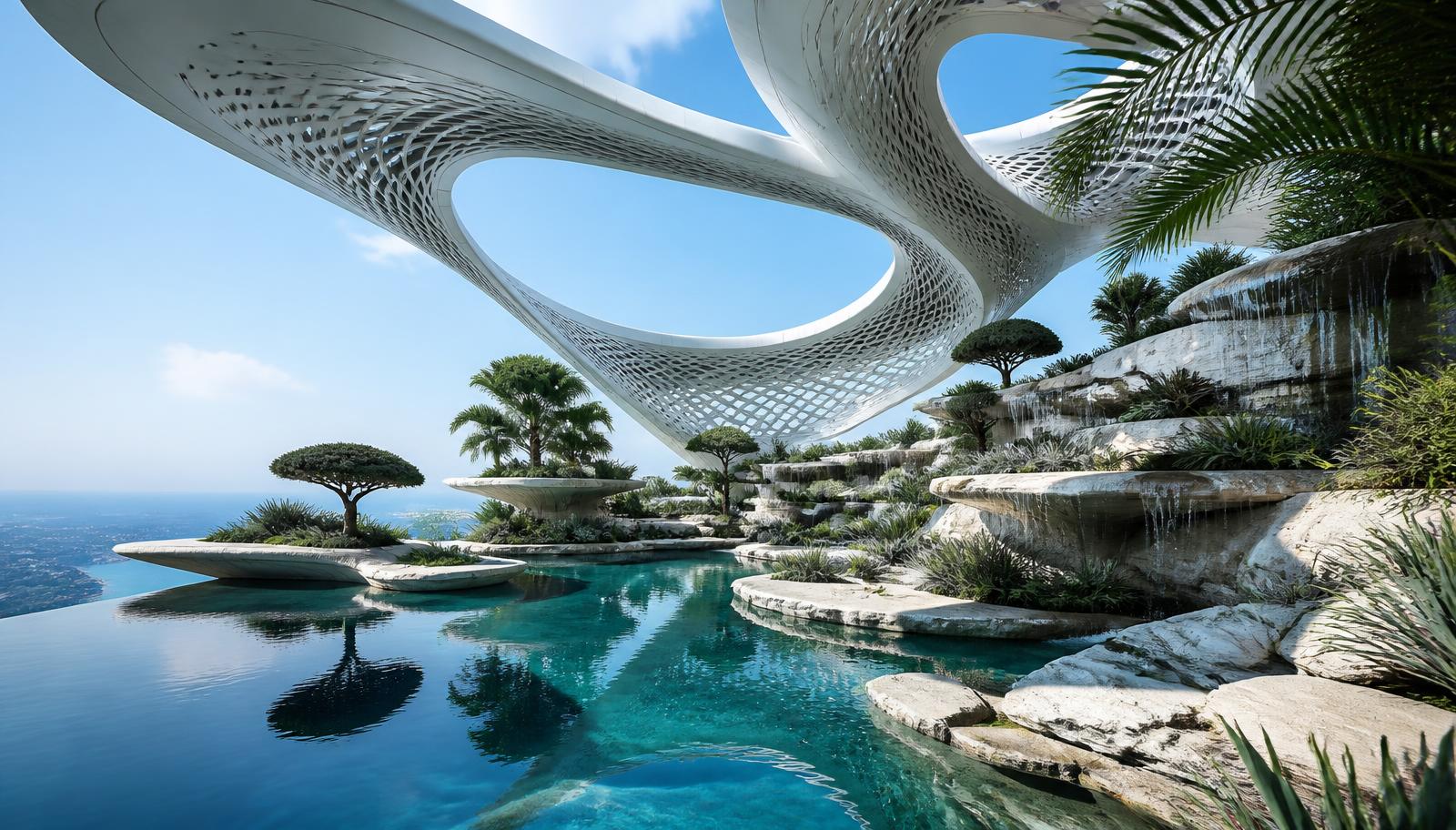
The garden becomes architecture
This is where garden design is heading, and it is impossible to ignore. A single sculptural ribbon of white lattice twists out over the water, floating stone islands carry their own sculptural trees, and cascades spill down the limestone terraces behind. Nothing here was added at the end of a build — the garden and the structure were drawn as one object, and that is the biggest shift of the next decade.
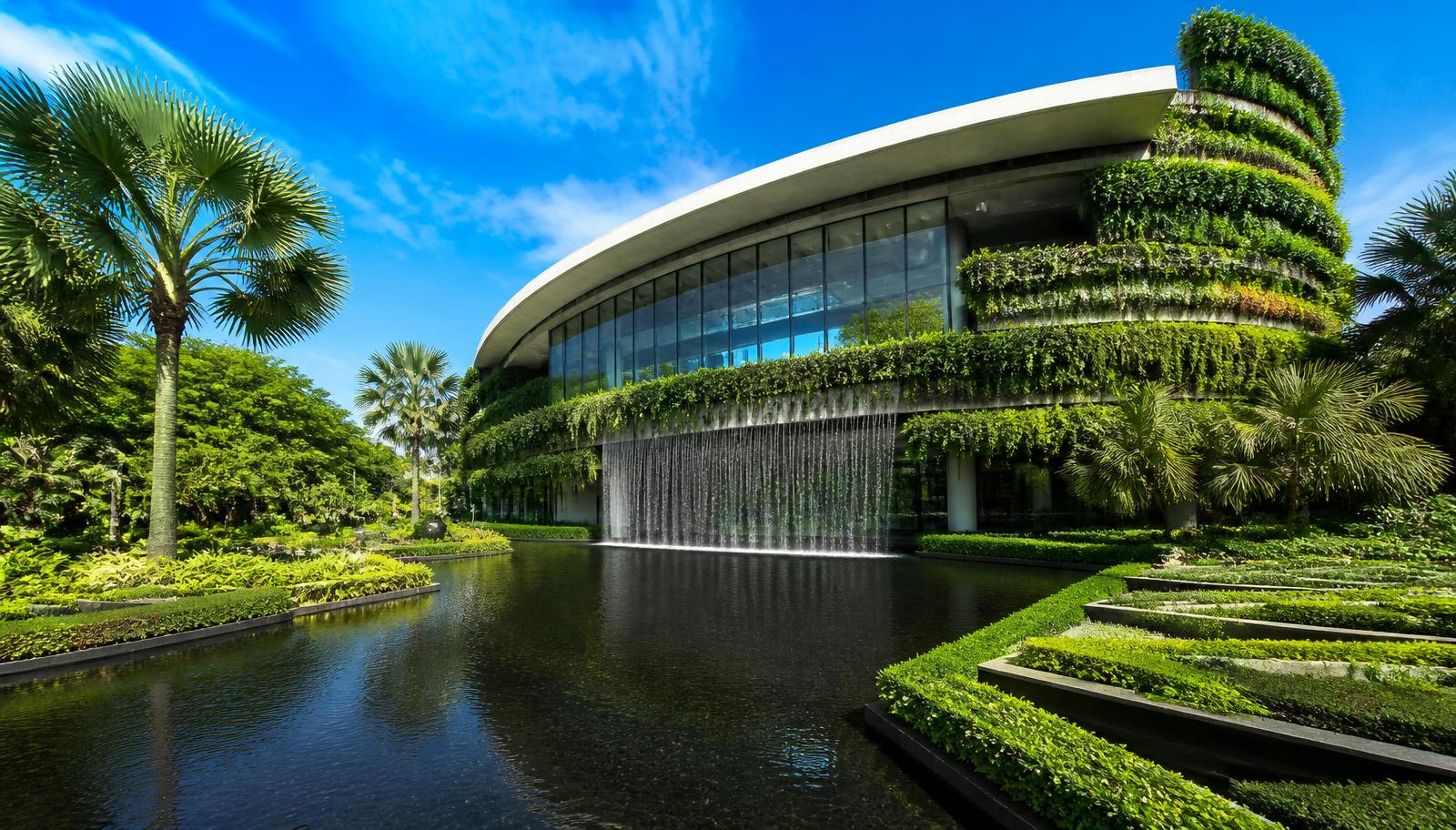
Four storeys of living wall, a sheet waterfall the full width of the building, and a black bottomed mirror pool that doubles every leaf above it. This is the future garden at full volume: plants used as facade, water used as floor, and geometry holding the whole thing together so the abundance never looks accidental.
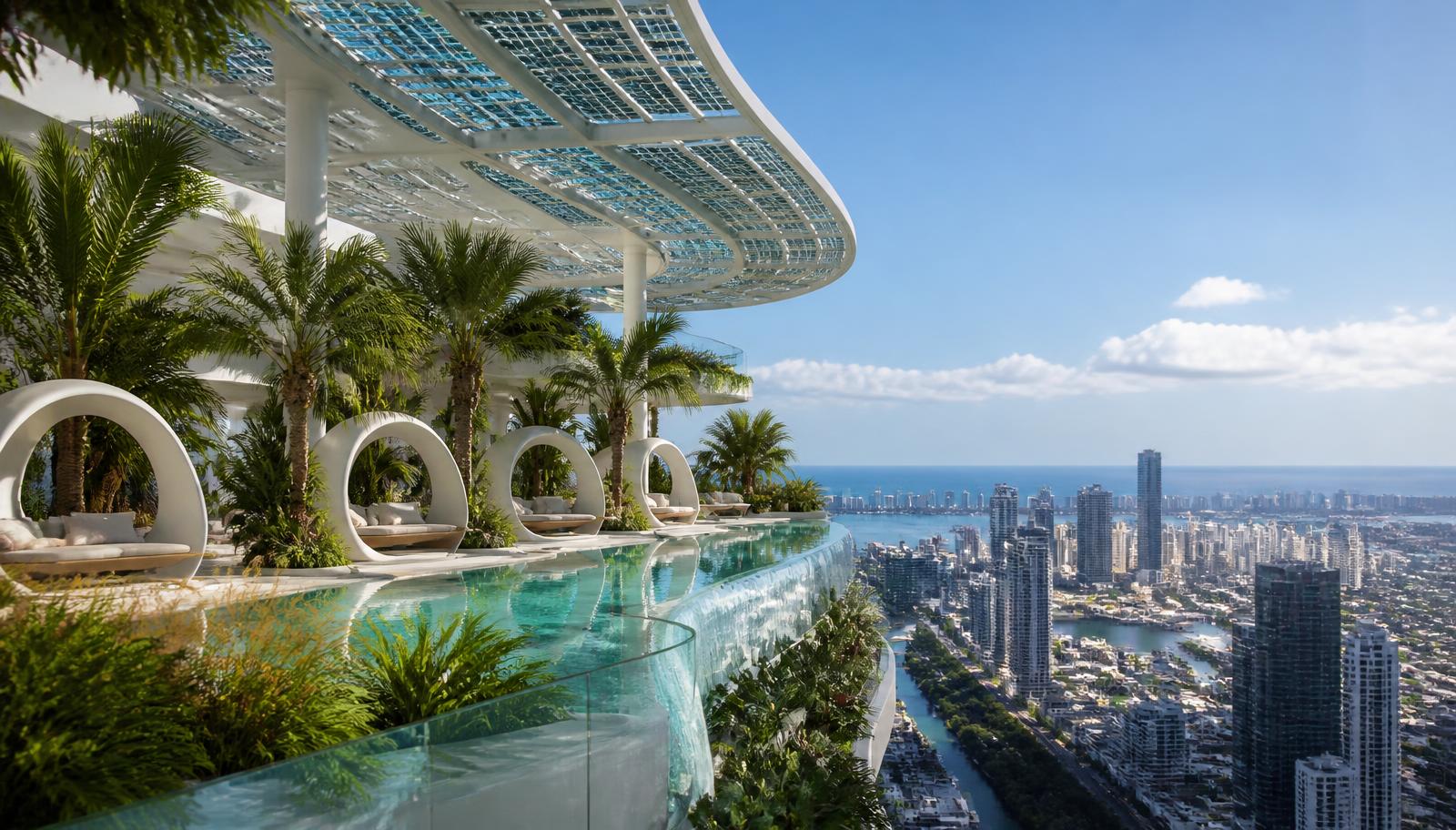
Gardens that climb upward
As land shrinks, the only direction left is up. A glass walled pool hangs over the skyline, white pod loungers sit under a curved solar canopy that powers the terrace, and a run of palms turns a rooftop slab into a jungle three hundred feet in the air. Nothing on the ground can compete with this view.
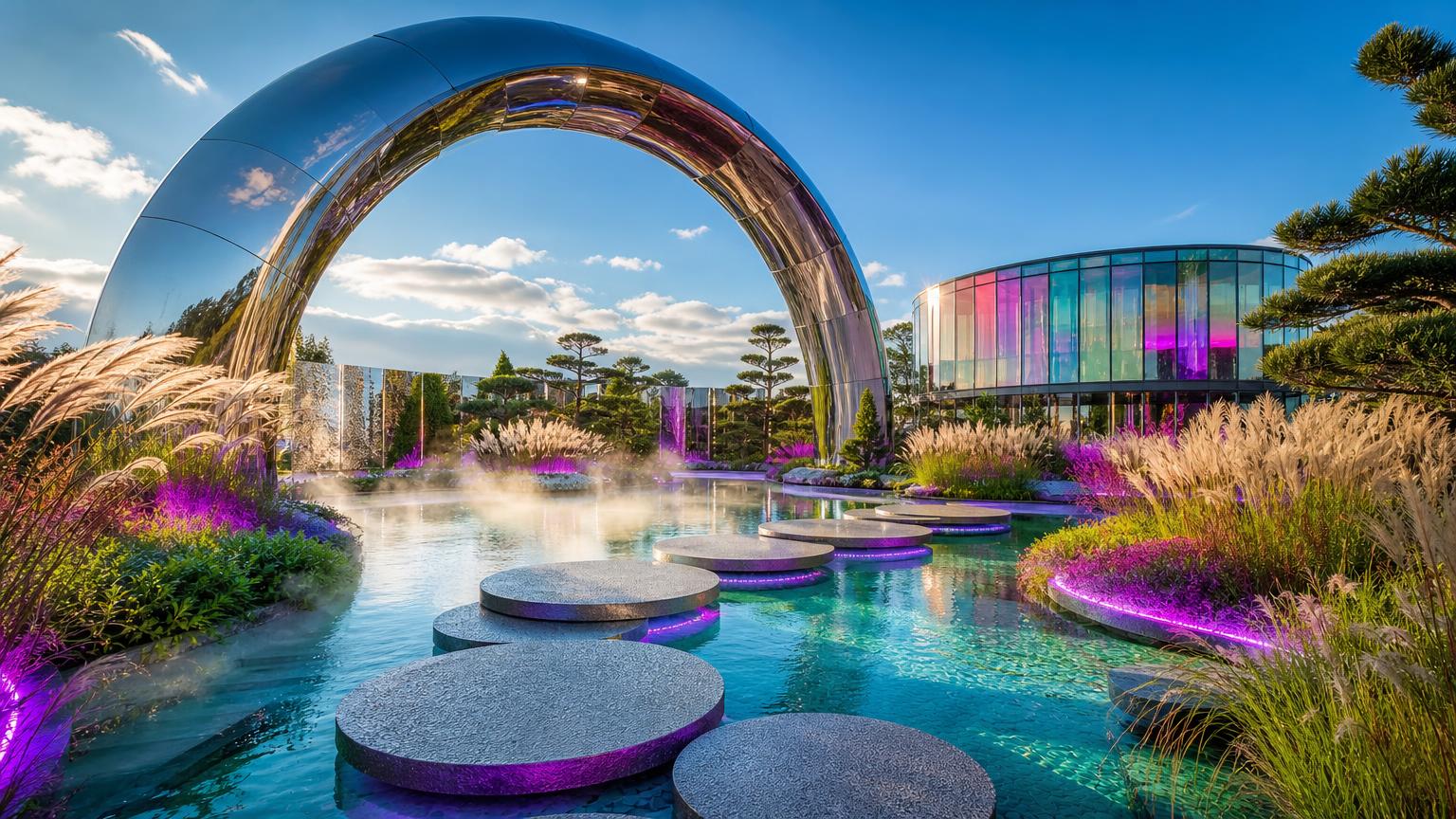
One monumental object, one path, one lagoon of mist — and now a wash of neon colour woven through the planting. Polished chrome picks up the sky, the stepping discs glow violet at their edges, and the prismatic pavilion shifts colour as you move. Dazzling does not mean loud; it means every surface catches light differently.
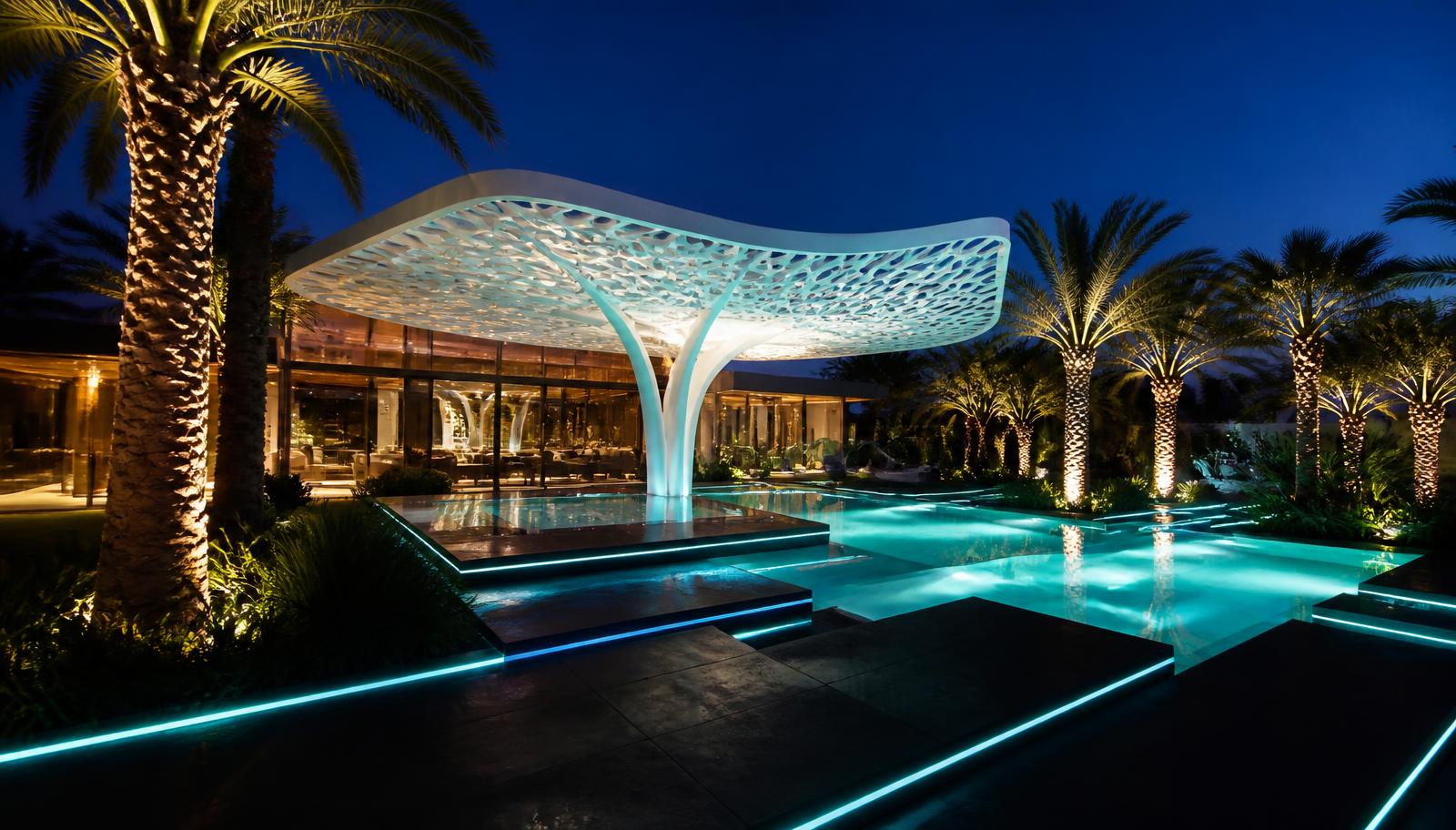
Then the sun goes down
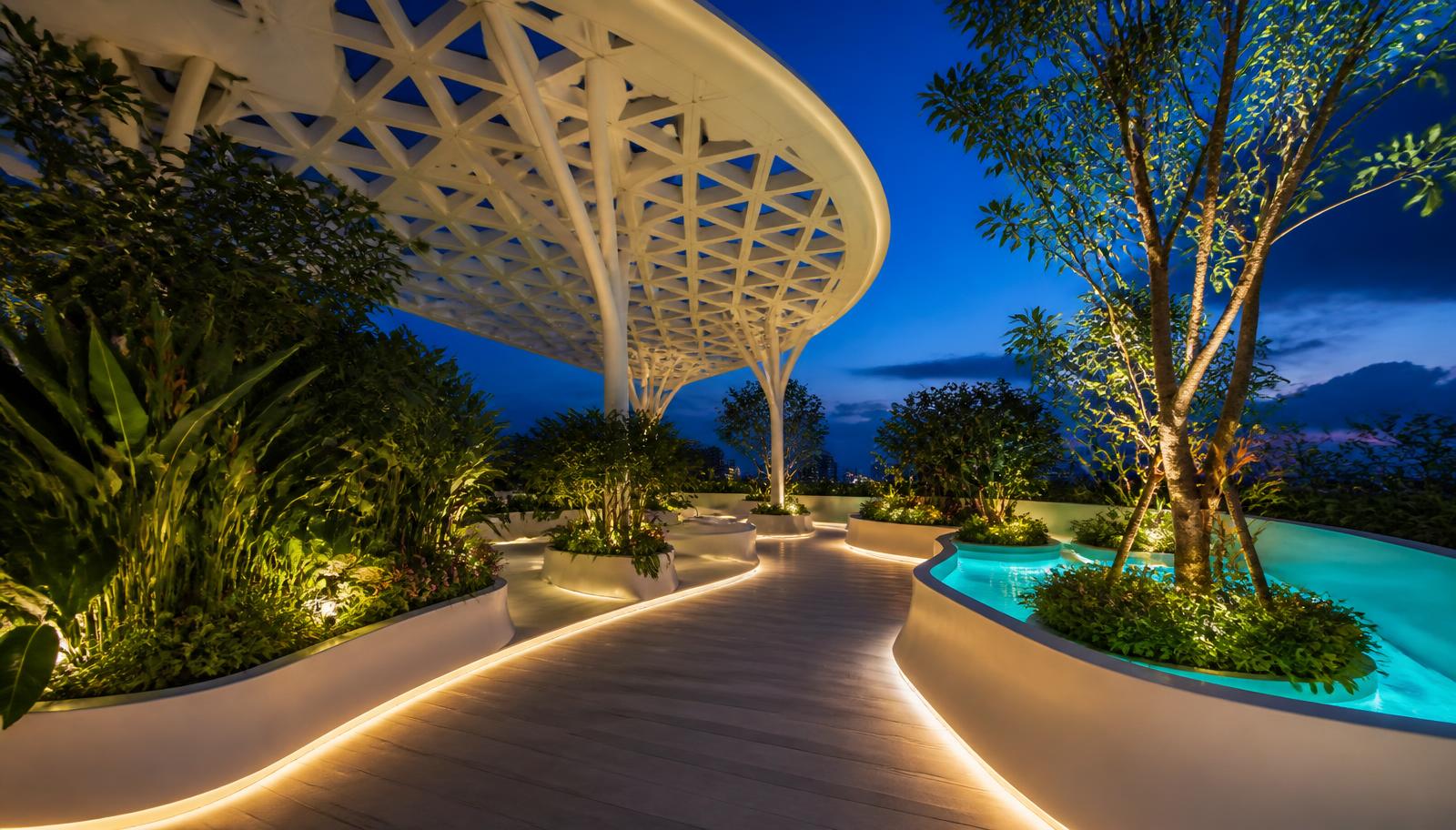
This is the same design language after dark, and it is effectively a different property. Cyan lines run through the black paving, the perforated canopy glows from within, the pool becomes a lantern and the palms are lit from the base up. Design your garden twice — once for sunlight, once for the switch.
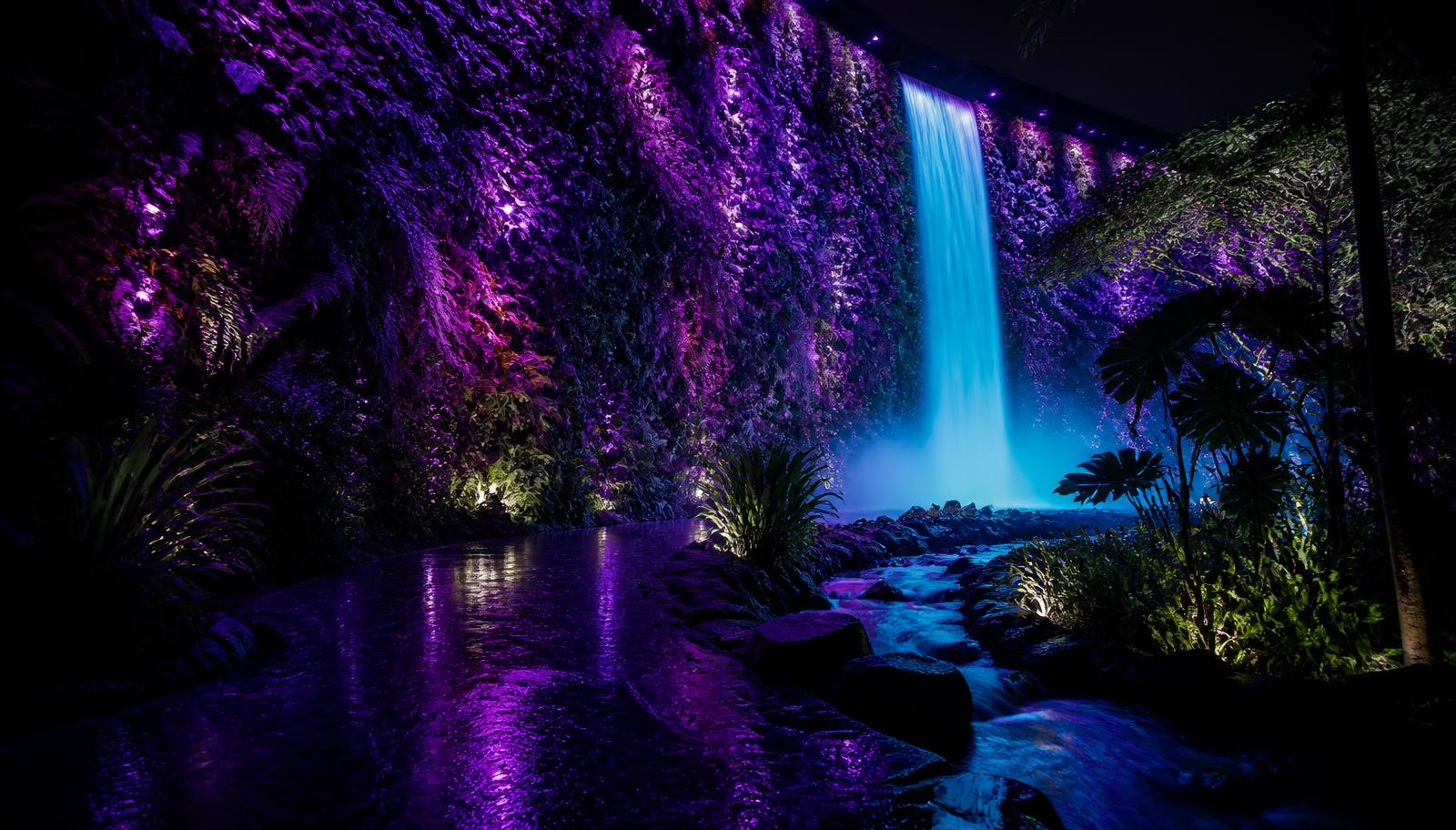
Programmable colour is the boldest tool in the night garden. Magenta and violet grow lighting turns a living wall into theatre while genuinely feeding the plants by day, and one cyan-lit waterfall supplies the sound, the movement and the only cool light in the scene.
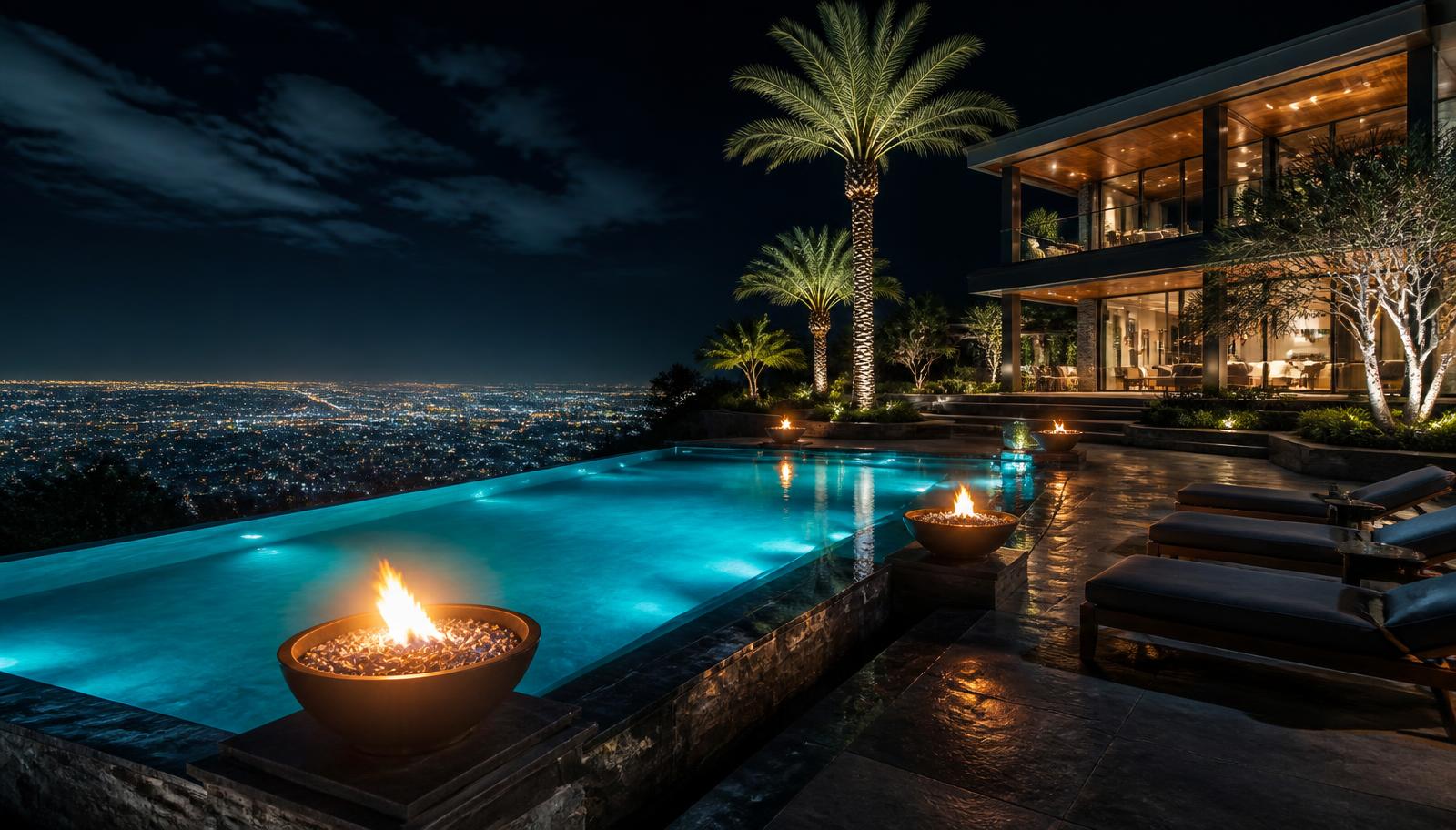
Lit water and open flame
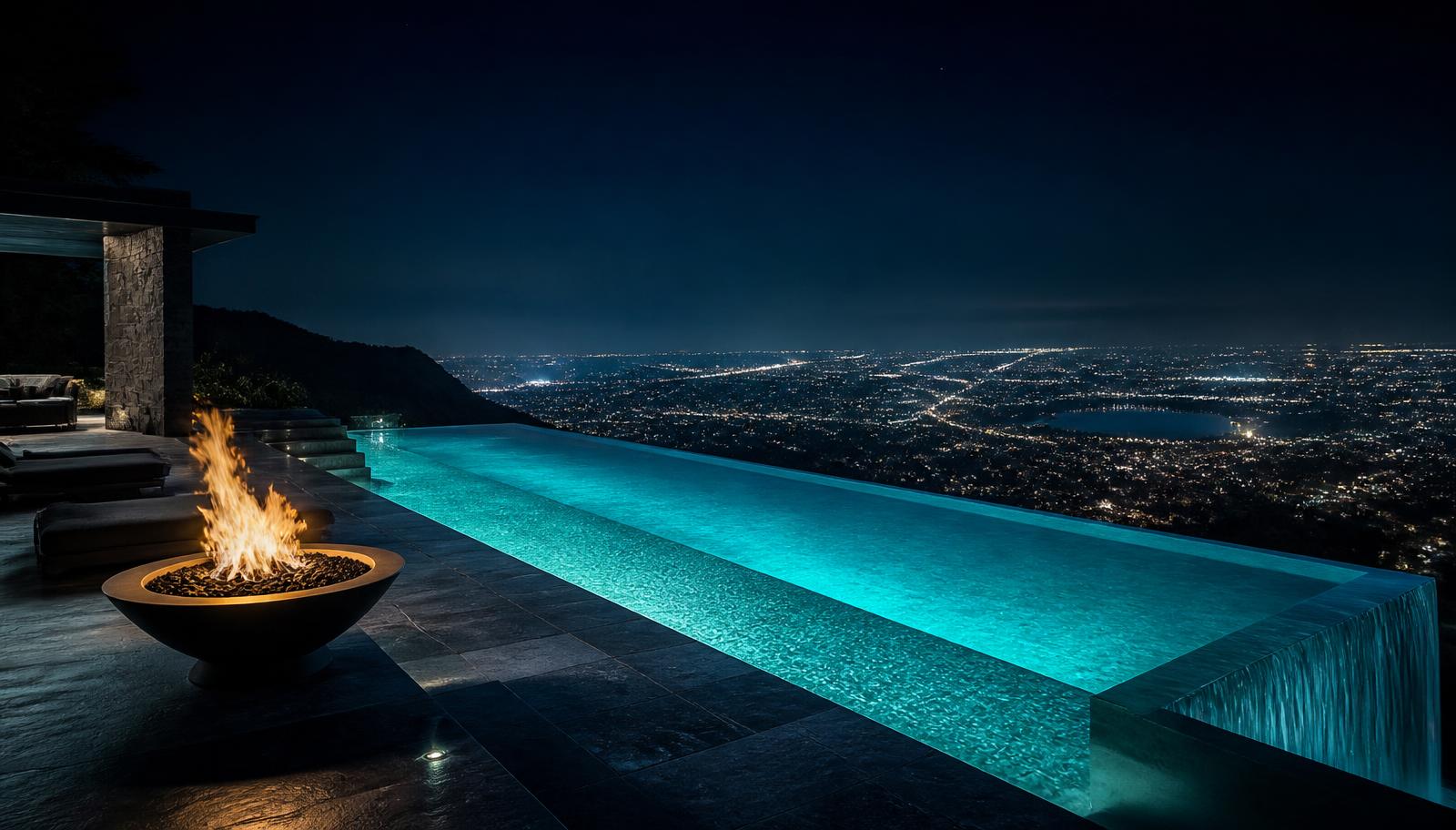
These are the two strongest night-time materials in any garden. Underwater light turns the pool into the brightest object on the property, fire bowls give the eye somewhere warm to land, and the city below does the rest. Everything else stays deliberately black.
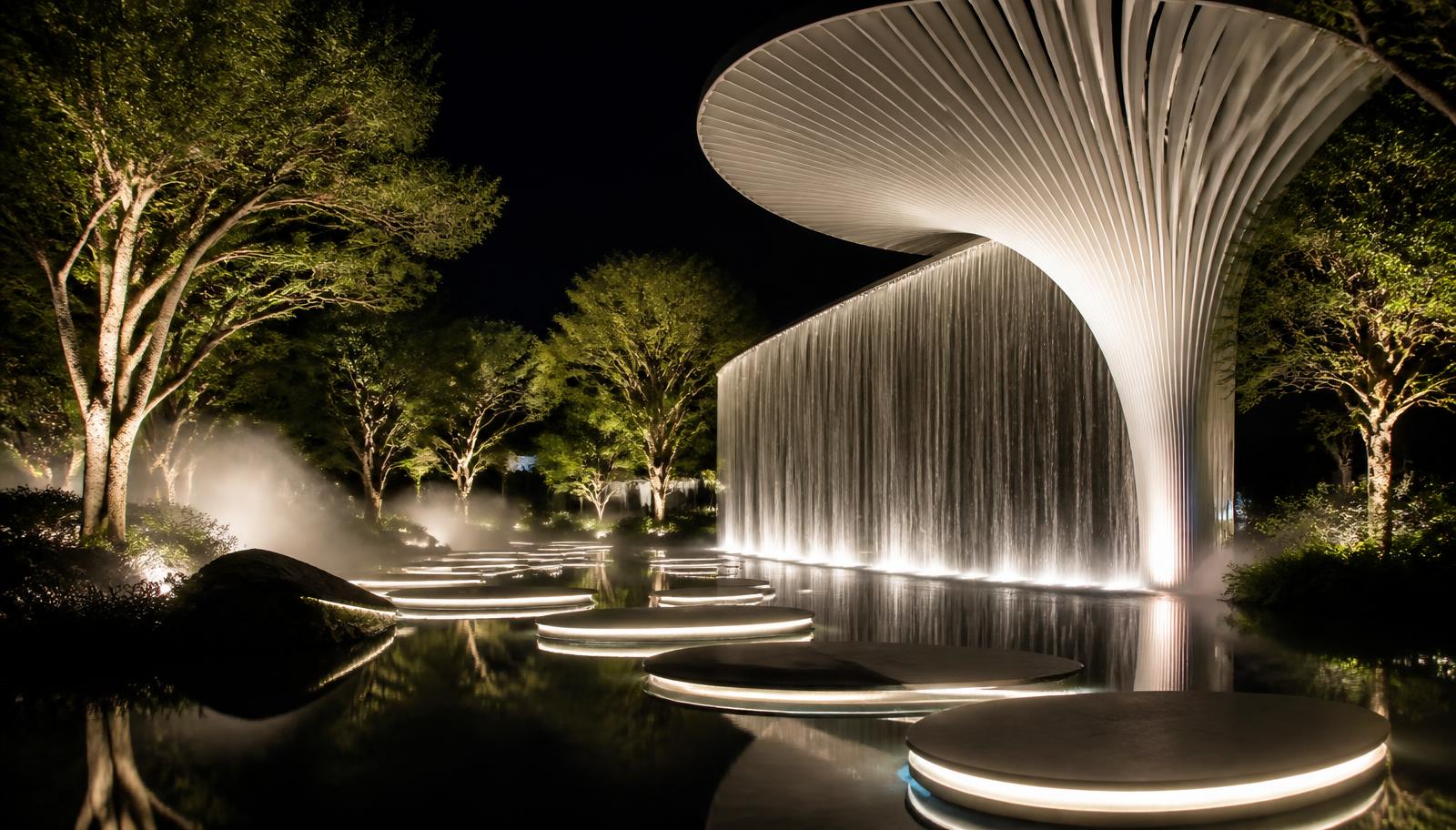
Light the treads, not the garden. Concealed strips under each floating disc make the path appear to hover, the ribbed canopy glows from inside its own structure, and a lit sheet of falling water closes the view. You never see a fitting — only what it touches.
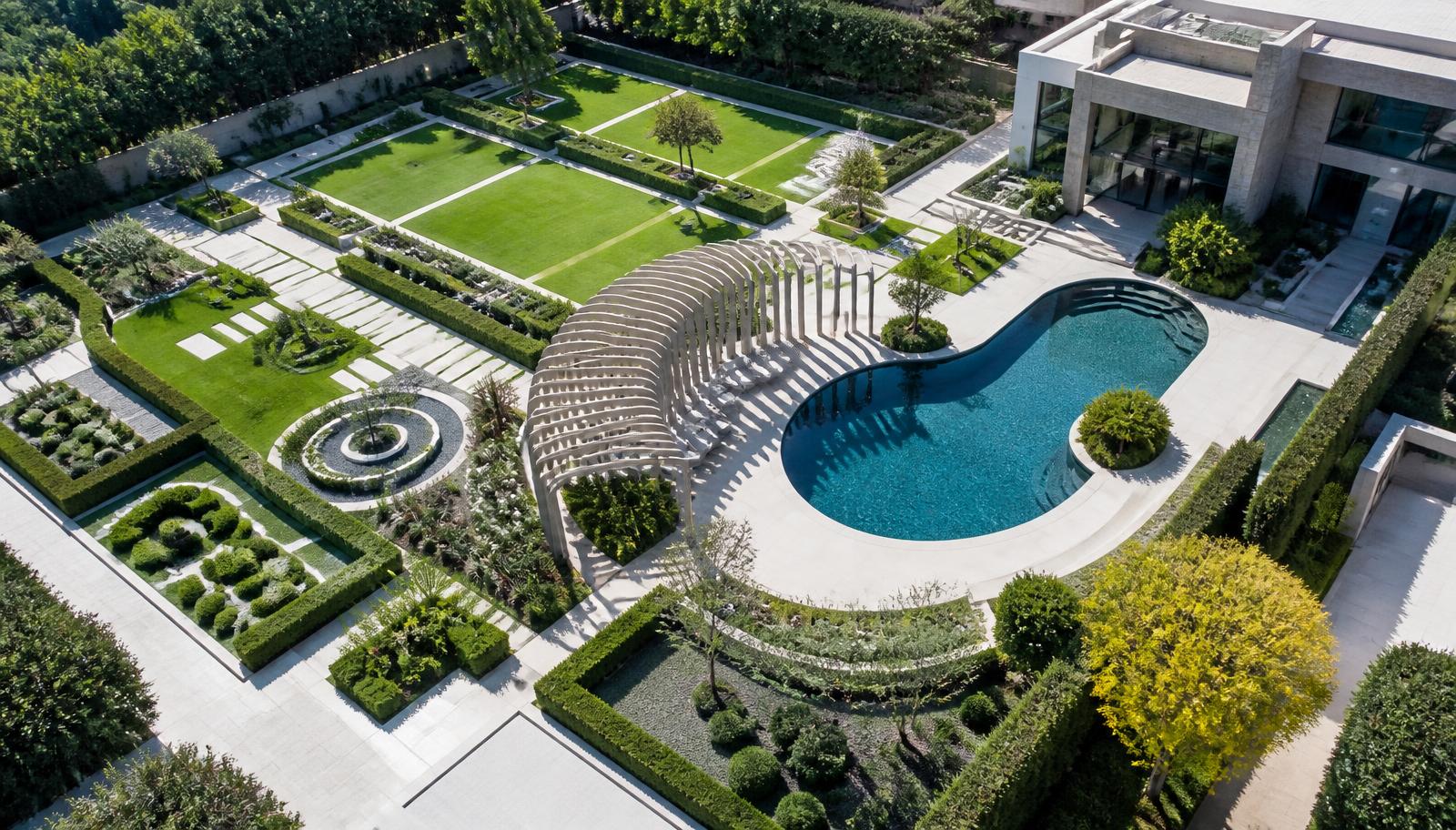
Plan view first
Geometric gardens live or die in the plan. Look at the property from above and resolve the big shapes — lawn panels, terrace grid, pool curve, hedge lines — before you think about plant names. Everything at eye level is a consequence of decisions made on that overhead drawing.
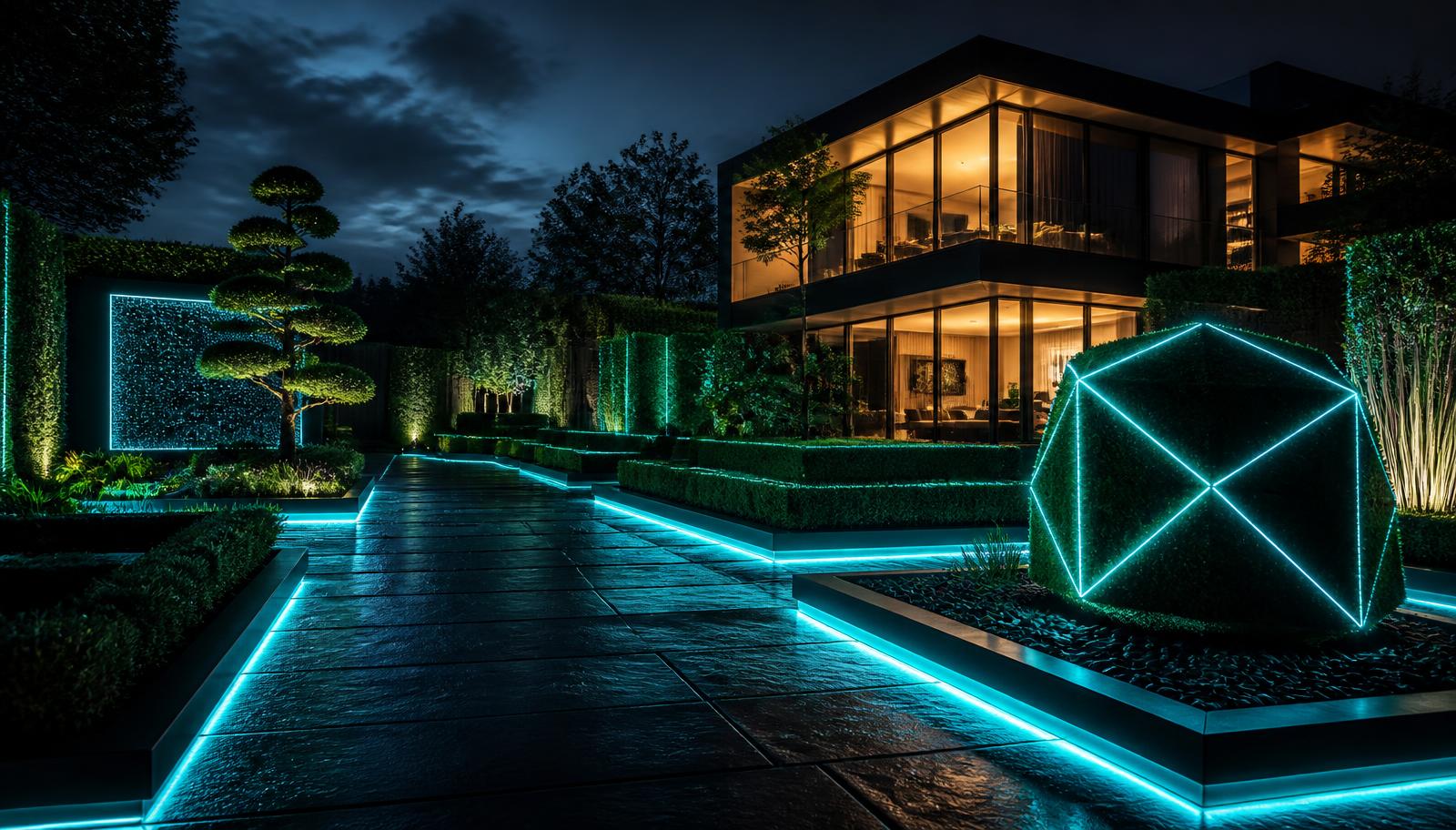
The garden switches on
This is the same kind of garden as the daylight images above, seen after dark, and it is effectively a different property. Cyan lines traced along paving edges, one lit geometric hedge as the hero, and the house glowing warm behind it. Design your garden twice — once for sunlight and once for the switch.
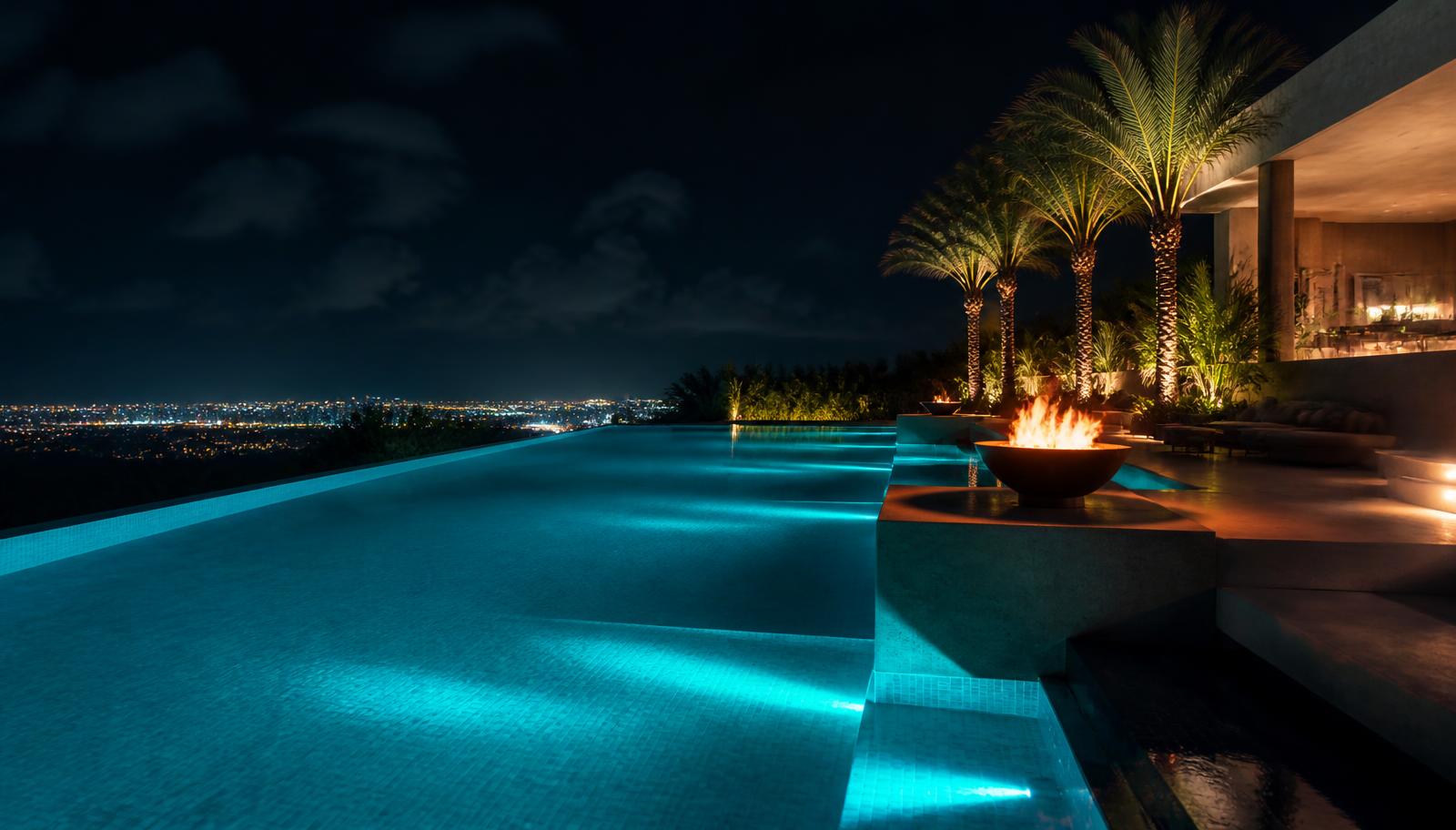
Lit water and open flame are the two strongest night-time tools in a garden. Turquoise underwater lighting turns the pool into a lantern, and one fire bowl on the axis gives the eye somewhere warm to land. Keep everything else dark and the contrast does the work.
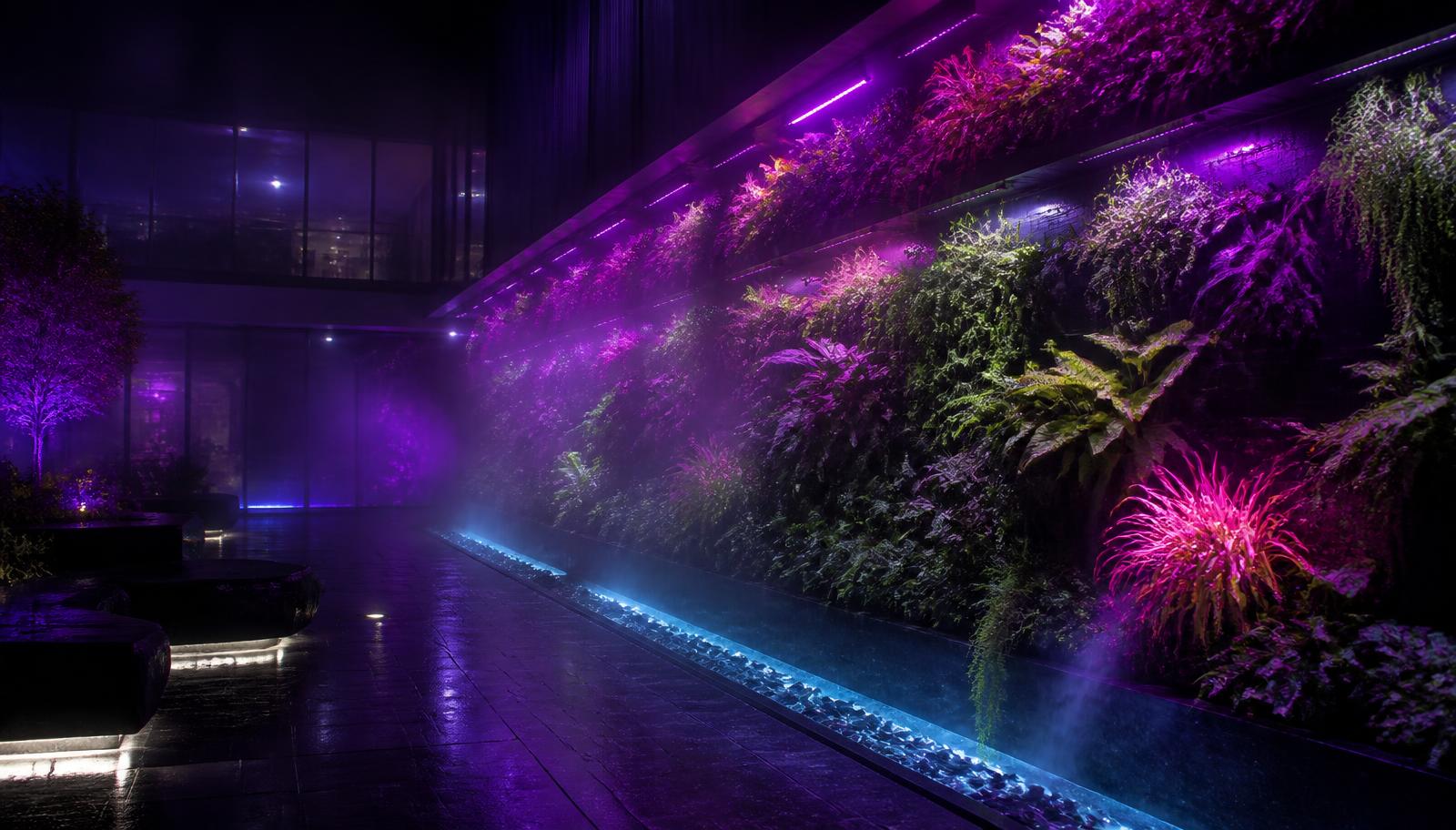
Colour as a night-time material
Programmable colour changes the mood of a courtyard in seconds. Magenta and violet grow lighting reads as theatrical after dark while genuinely helping the plants during the day, and a cyan strip washing a pebble channel finishes the composition at floor level.
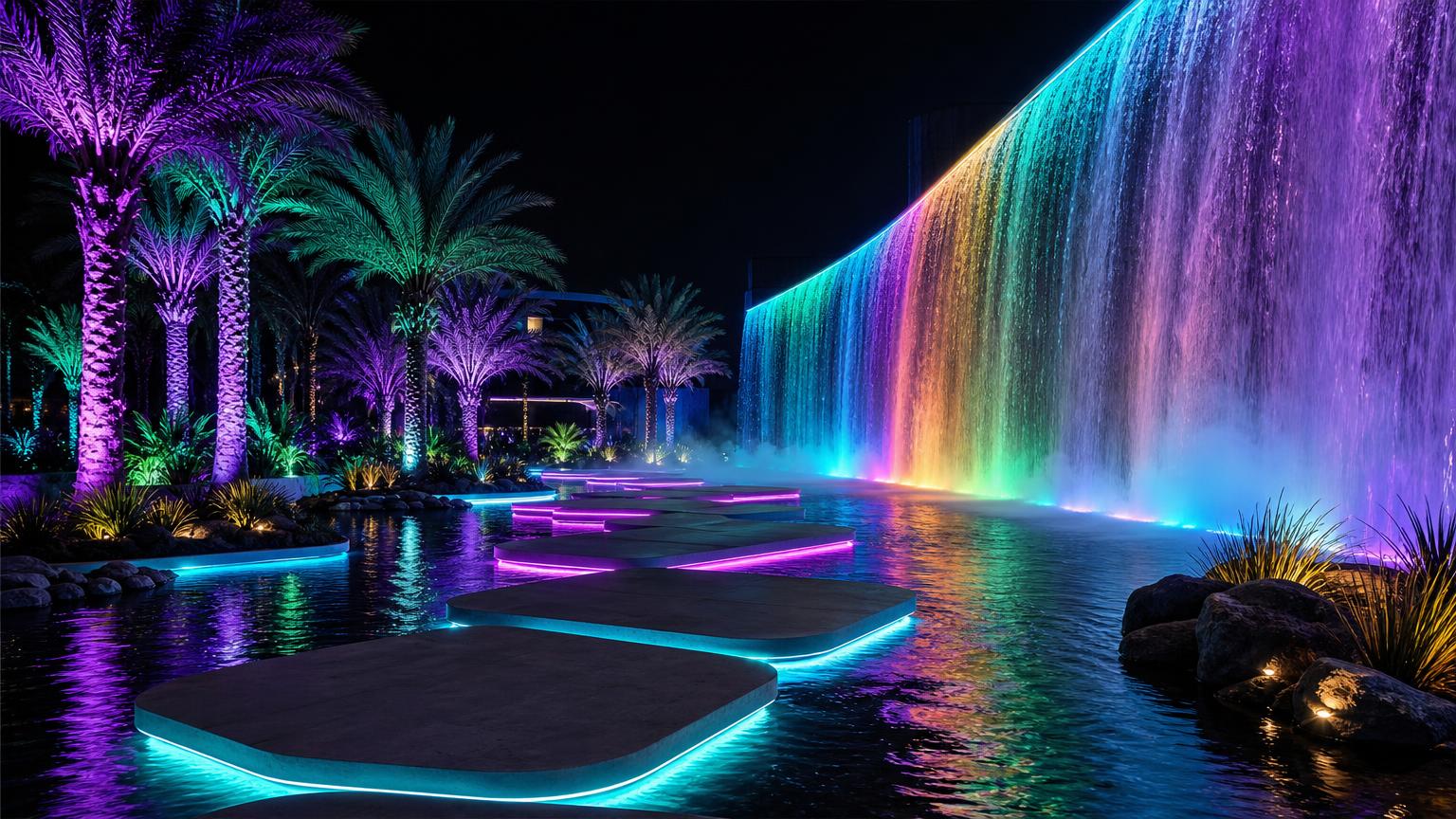
Light the treads, and then make the water a canvas. Neon strips under each floating platform turn the path into a glowing chain, while a waterfall wall washed in shifting rainbow LED becomes the whole garden's heartbeat. Colour is no longer decoration here — it is the structure of the night.
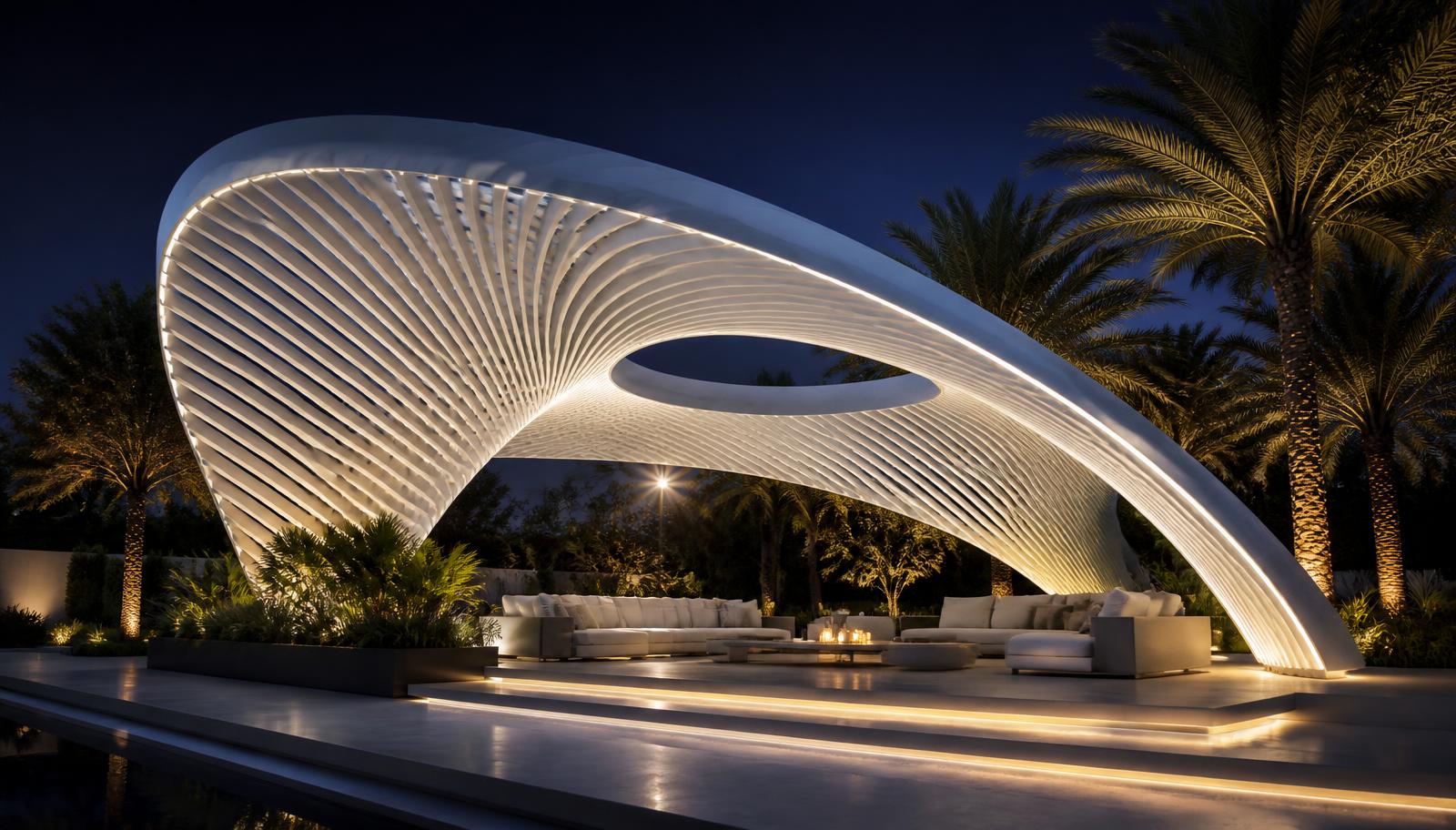
One object, endlessly photographed
Future gardens increasingly include a single sculptural structure that carries the whole identity of the property. Ribbed, CNC-cut and edge-lit, it is a shade canopy by day and a glowing sculpture by night — the element every visitor photographs.
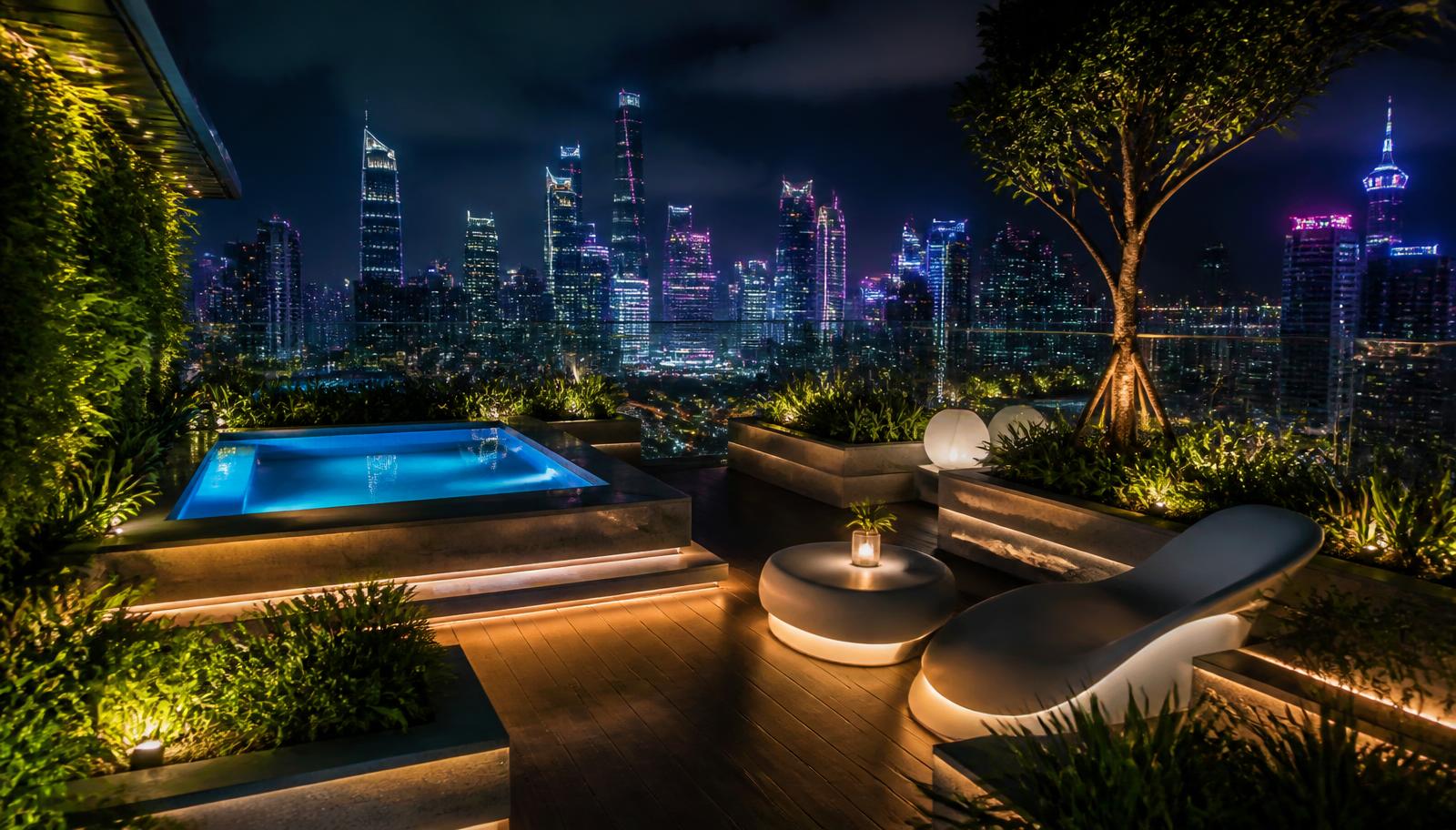
On a roof, the borrowed view is the garden's best planting. Keep the lighting low and warm so the skyline stays visible, wash light along planter edges instead of aiming it upward, and let the plunge pool supply the only cool colour on the terrace.
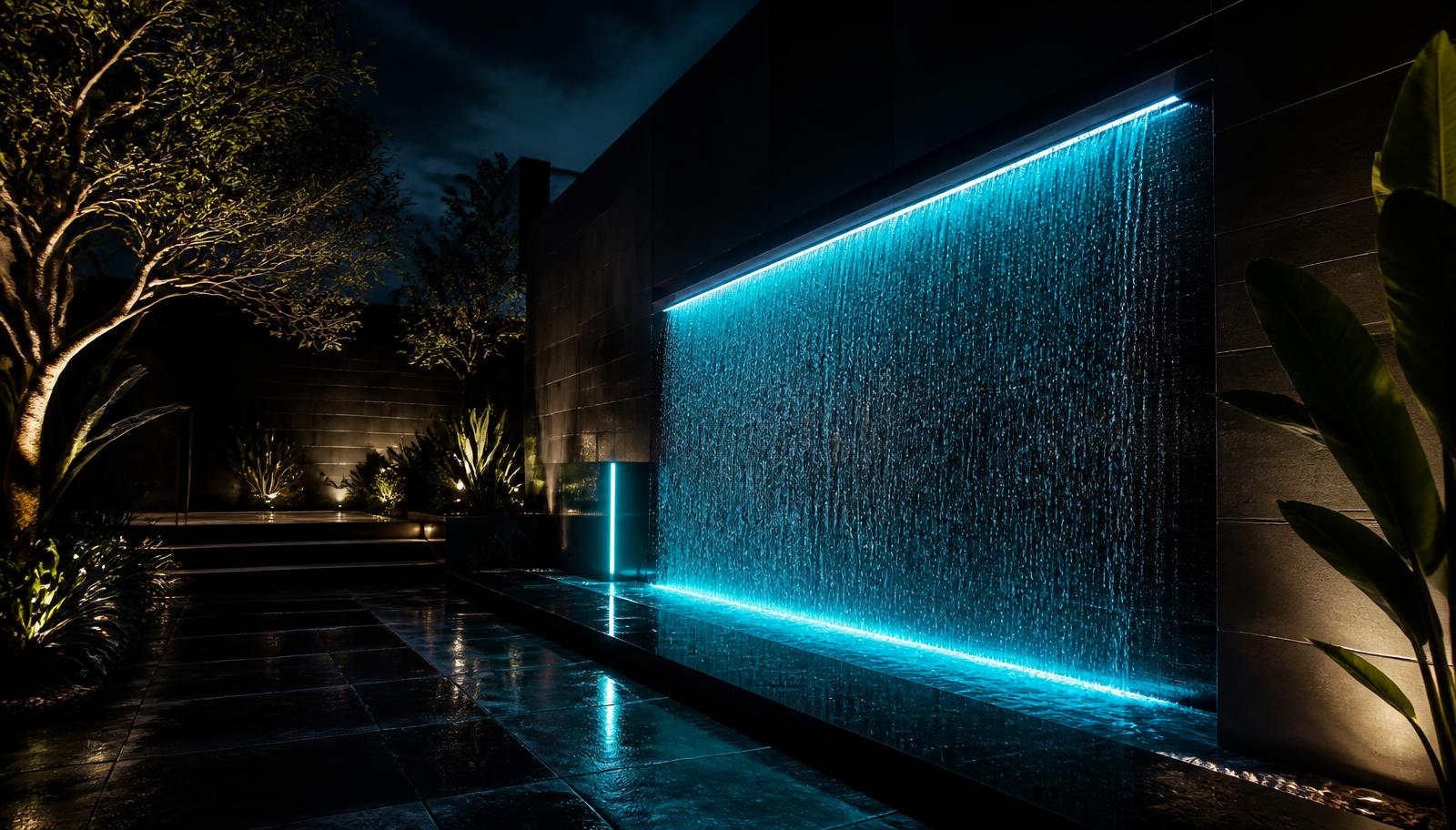
Radiating water walls
A slot-lit water wall is the most reliable wow feature in a small garden. The moving sheet catches light, throws sound over neighbourhood noise, and needs less than a square metre of floor. Light it from the top and the bottom only, never from the front.
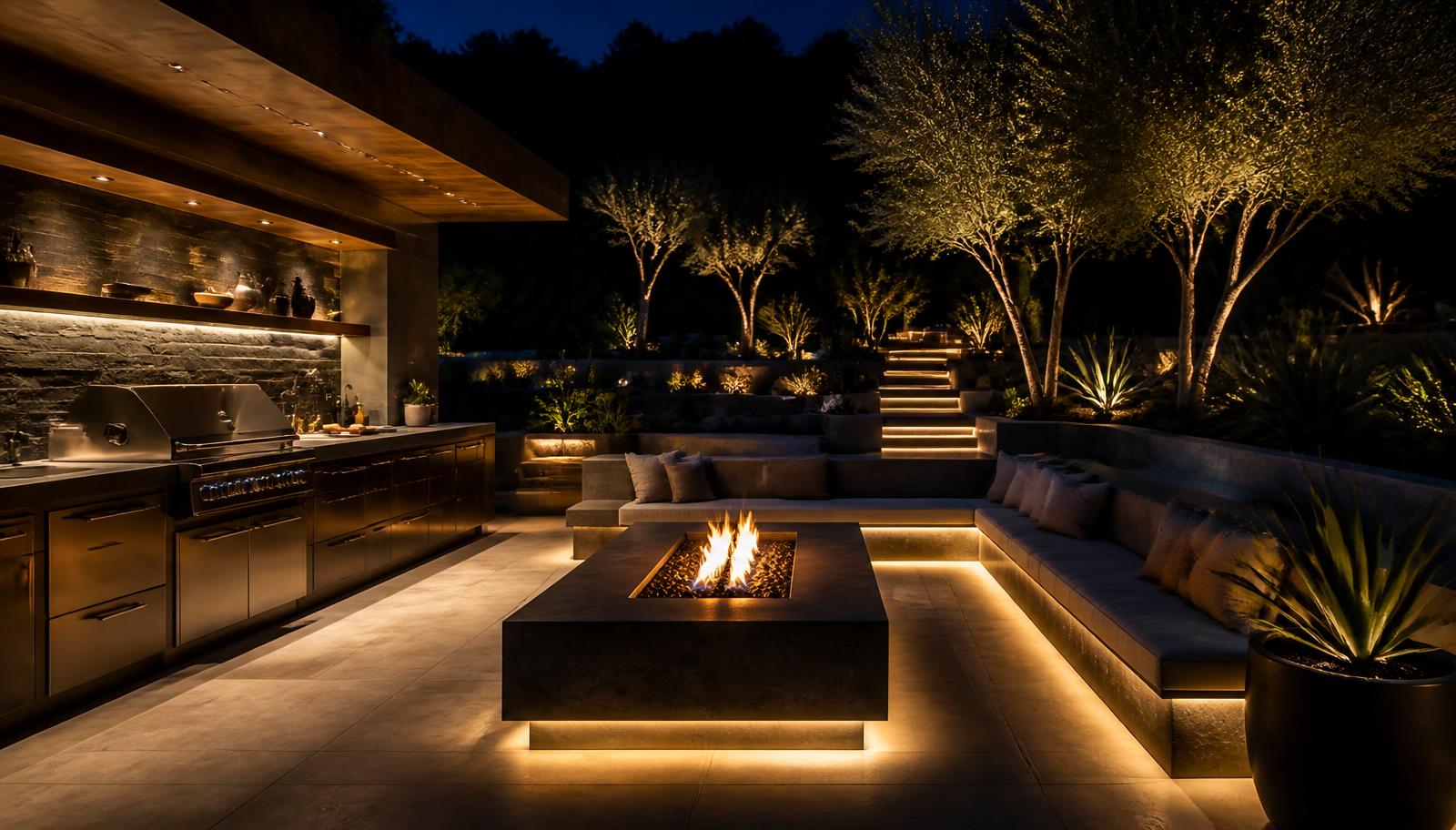
Strip lighting tucked beneath bench seats, steps and counters makes an entertaining terrace feel like a hotel without a single visible fitting. Add one long fire table and the space works in the middle of winter, which is where the real value of a future garden sits.
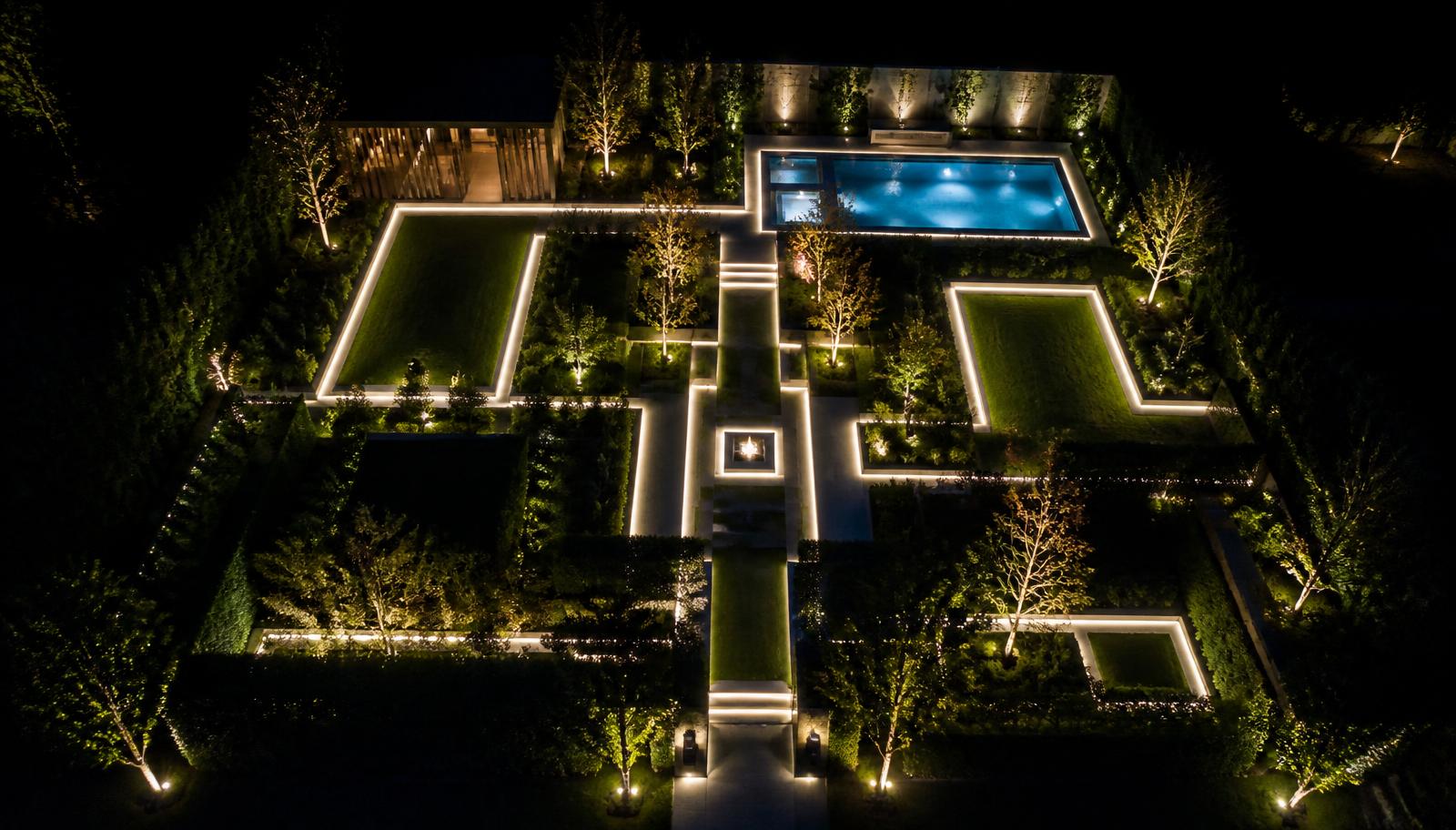
Night geometry from above
From a drone at night, a well lit garden becomes a drawing of itself. Outlining lawn panels and path edges is what produces this effect, and it is the clearest proof that the plan you resolved on paper was worth resolving properly.
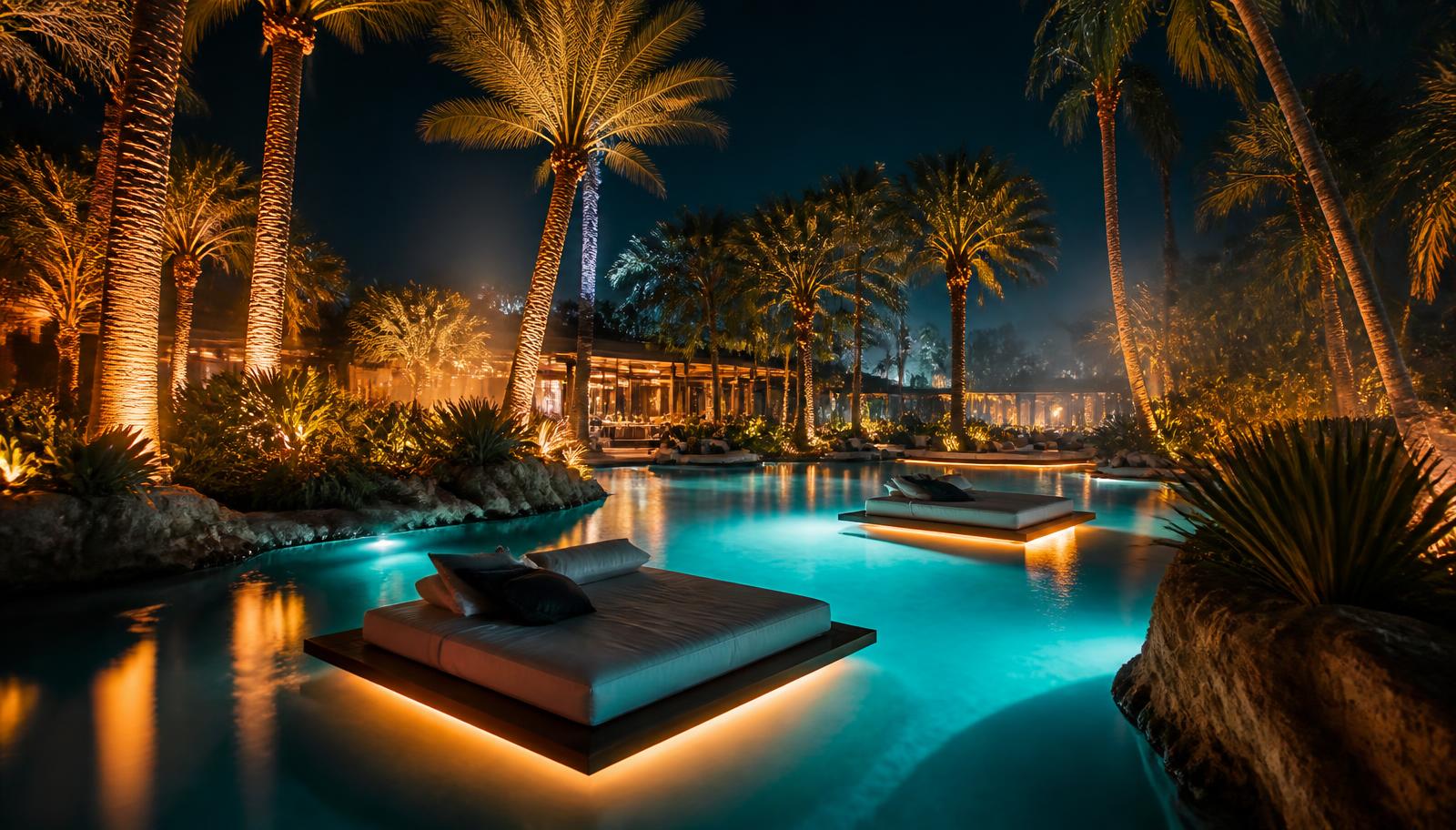
Resort lighting is generous with warm light on trunks and stingy everywhere else. Uplighting the palms builds a lit ceiling, the lagoon supplies the glow at ground level, and floating day beds edge-lit from below finish the scene without a single bright fitting in view.
Arrival after dark
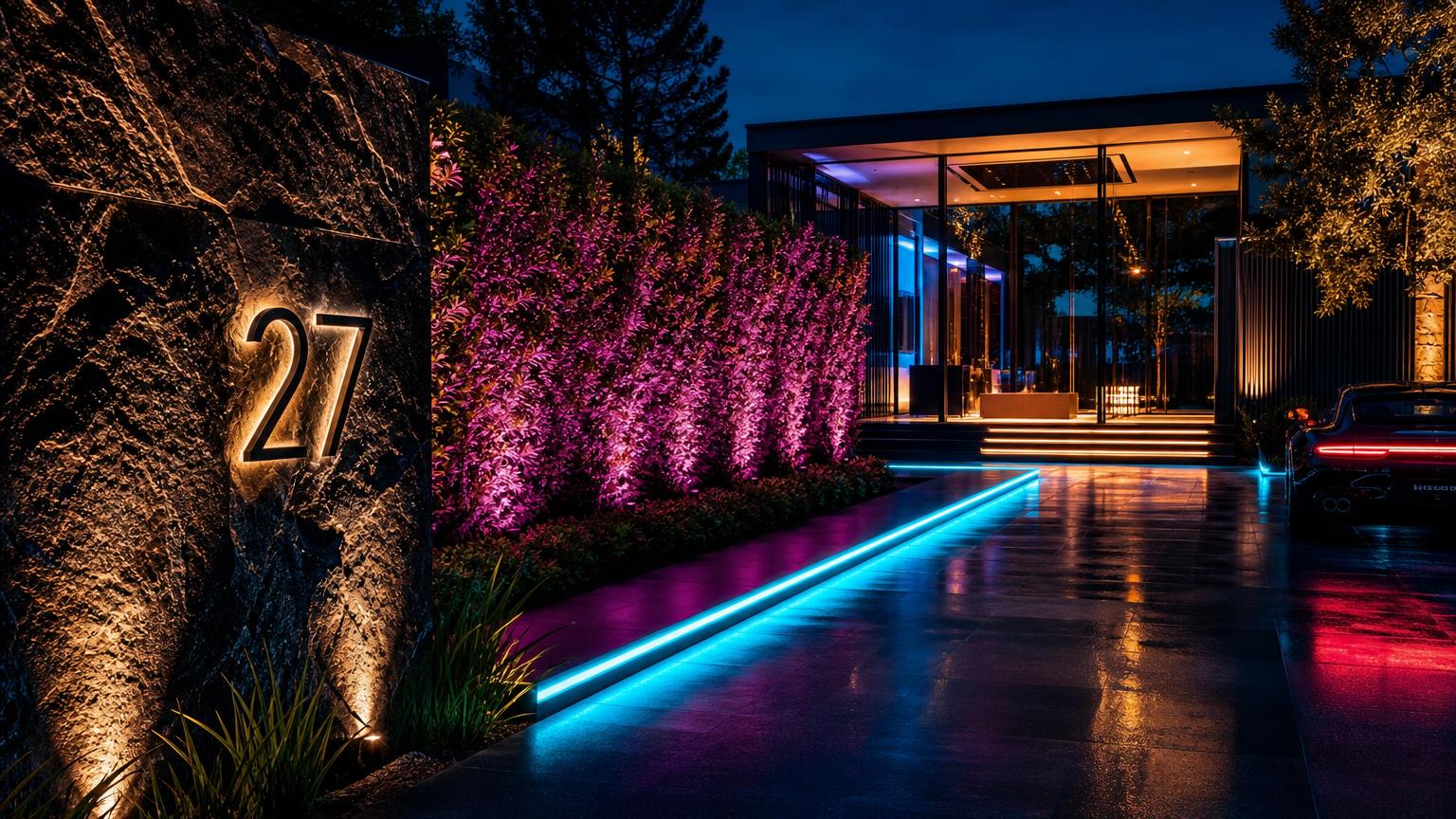
The front yard is where the future garden makes its first impression, and at night that impression is written in neon. Graze the texture of the entry wall, backlight the house number, run a cyan LED line along the driveway edge, and wash one sculptural hedge in magenta. The rest stays black, so the colour sings.
Beautiful and productive
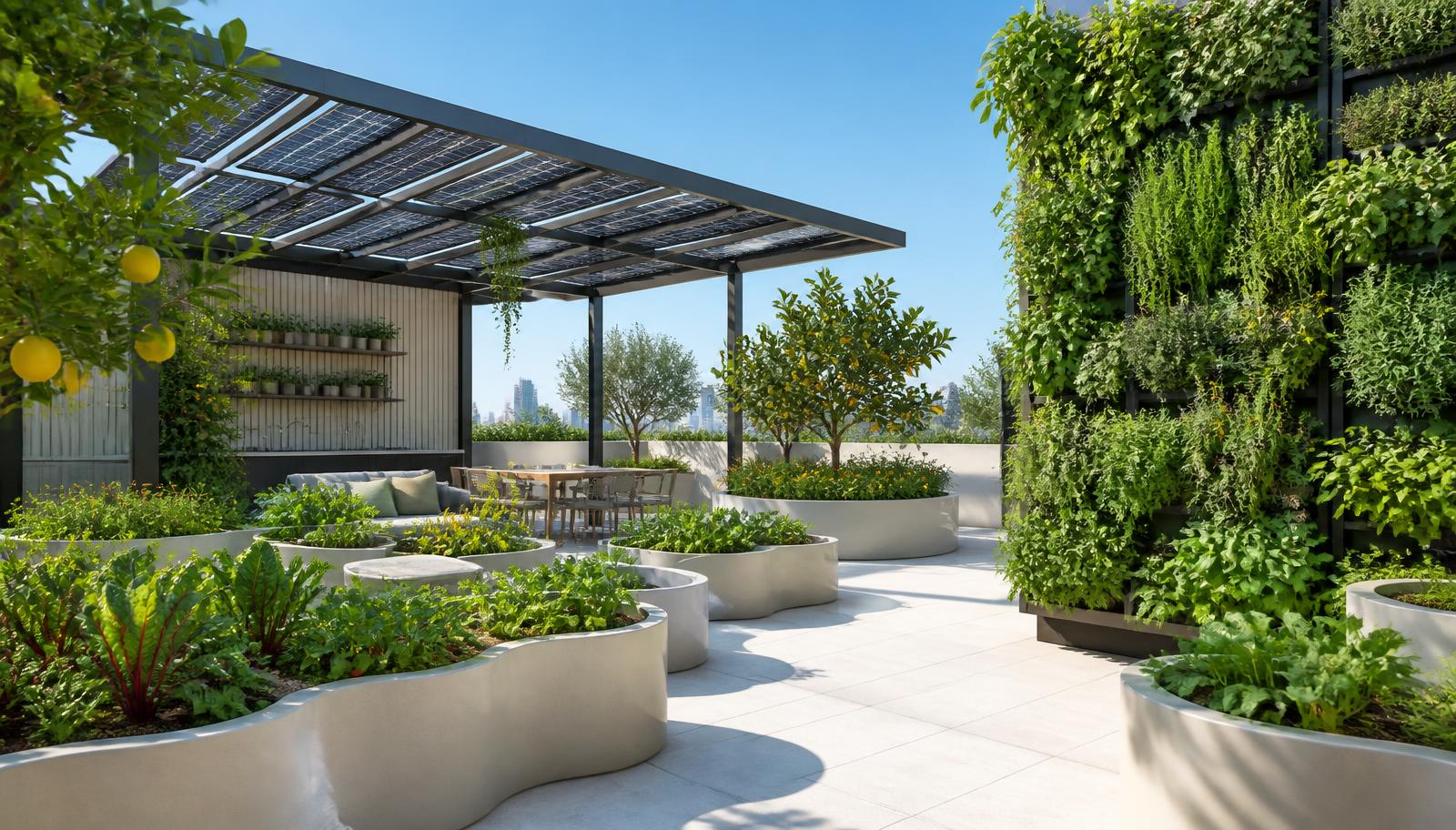
Edible landscaping is shedding its scruffy reputation. Sculptural raised beds, a vertical herb wall and a solar pergola overhead deliver food, shade and power from the same footprint — and it still looks like a designed terrace rather than an allotment.
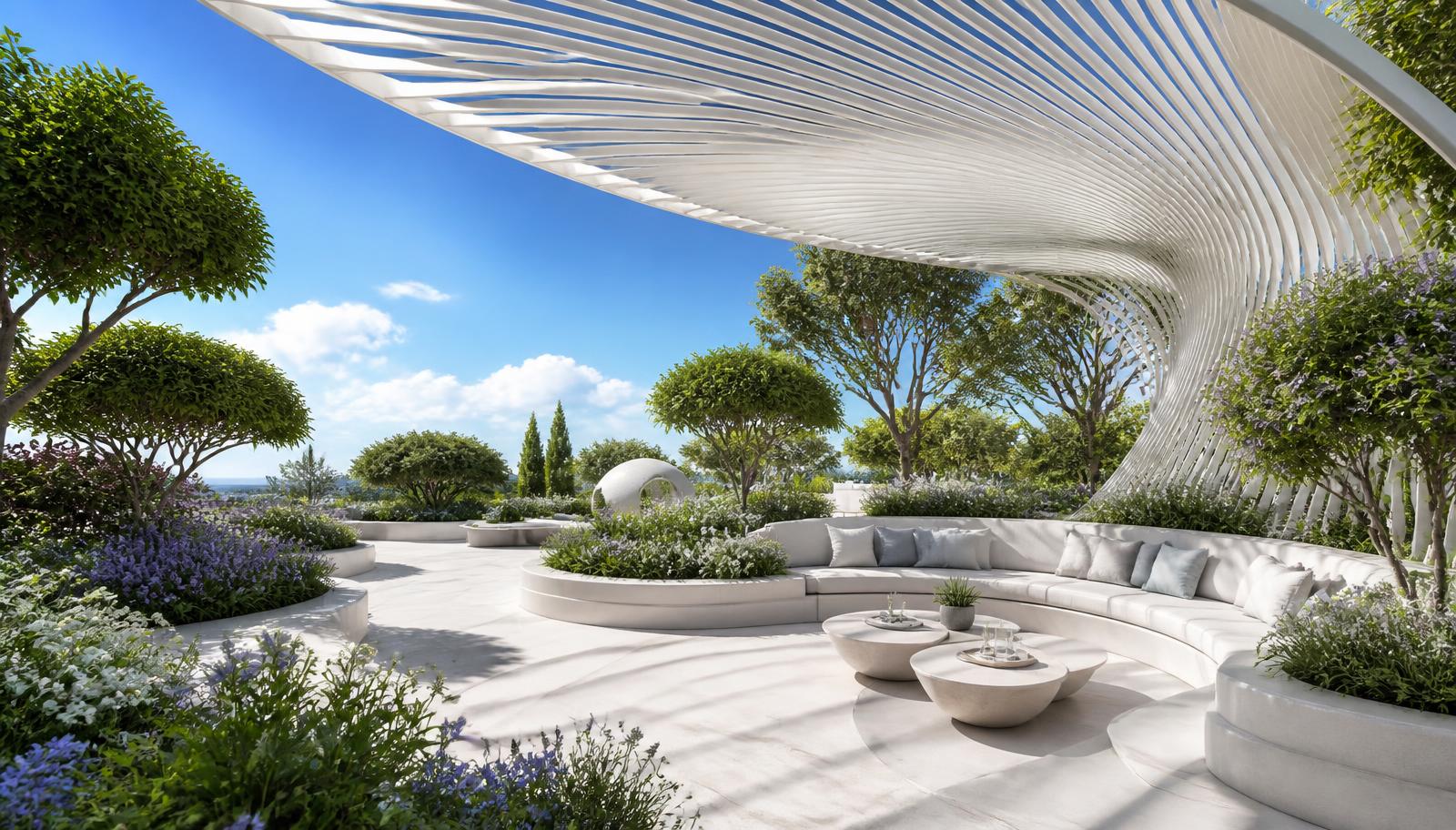
Fabrication technology is why these forms are arriving in ordinary gardens. Curved slat canopies and curved seating are now cut from a file, which means the shape costs little more than the straight version and delivers ten times the effect.
The boundary disappears
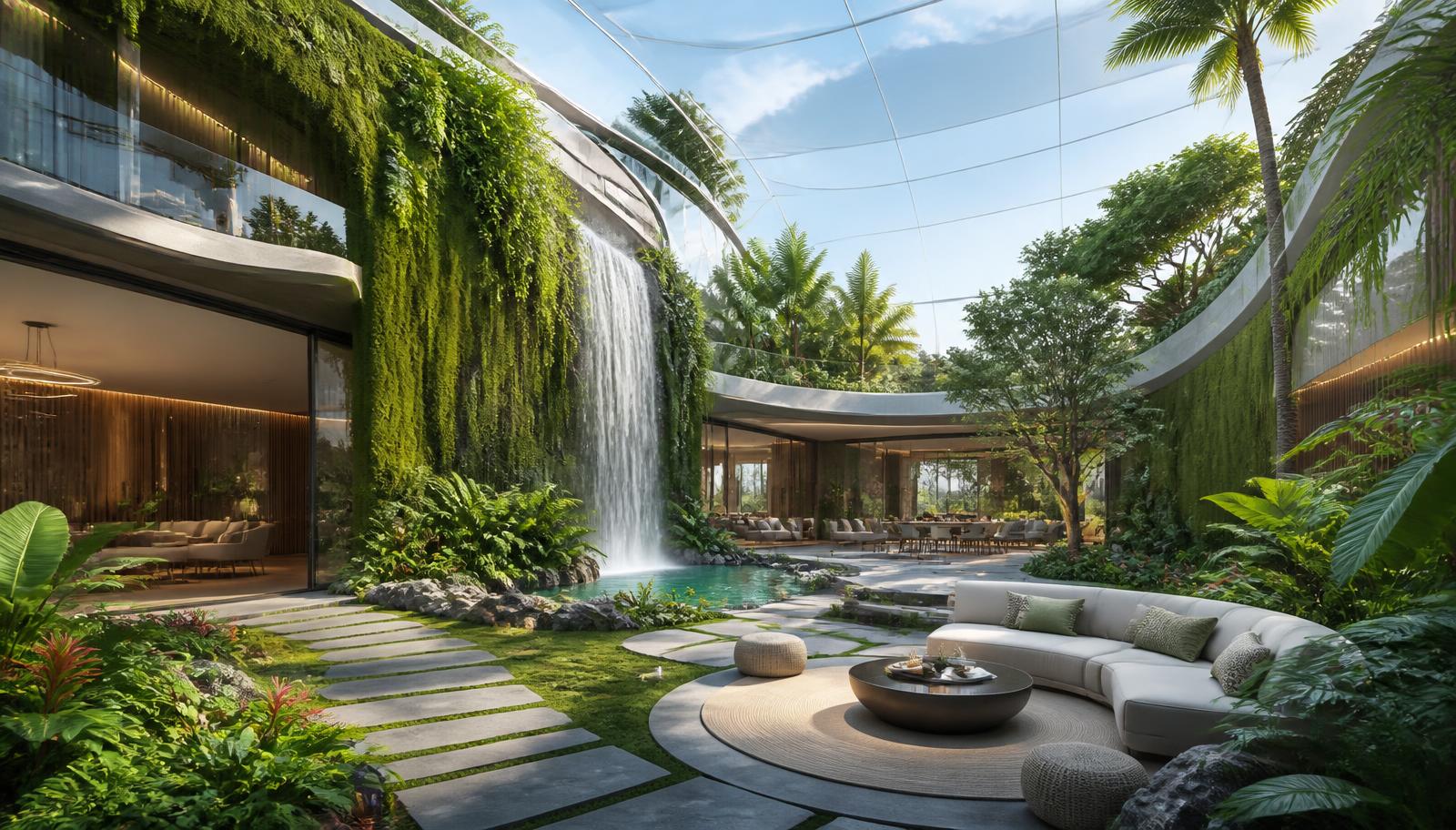
The most transformative future garden idea is the one that removes the wall entirely. A climate-tempered courtyard with a moss wall, a waterfall and full-height glass makes the garden a room you live in year round, in any weather.
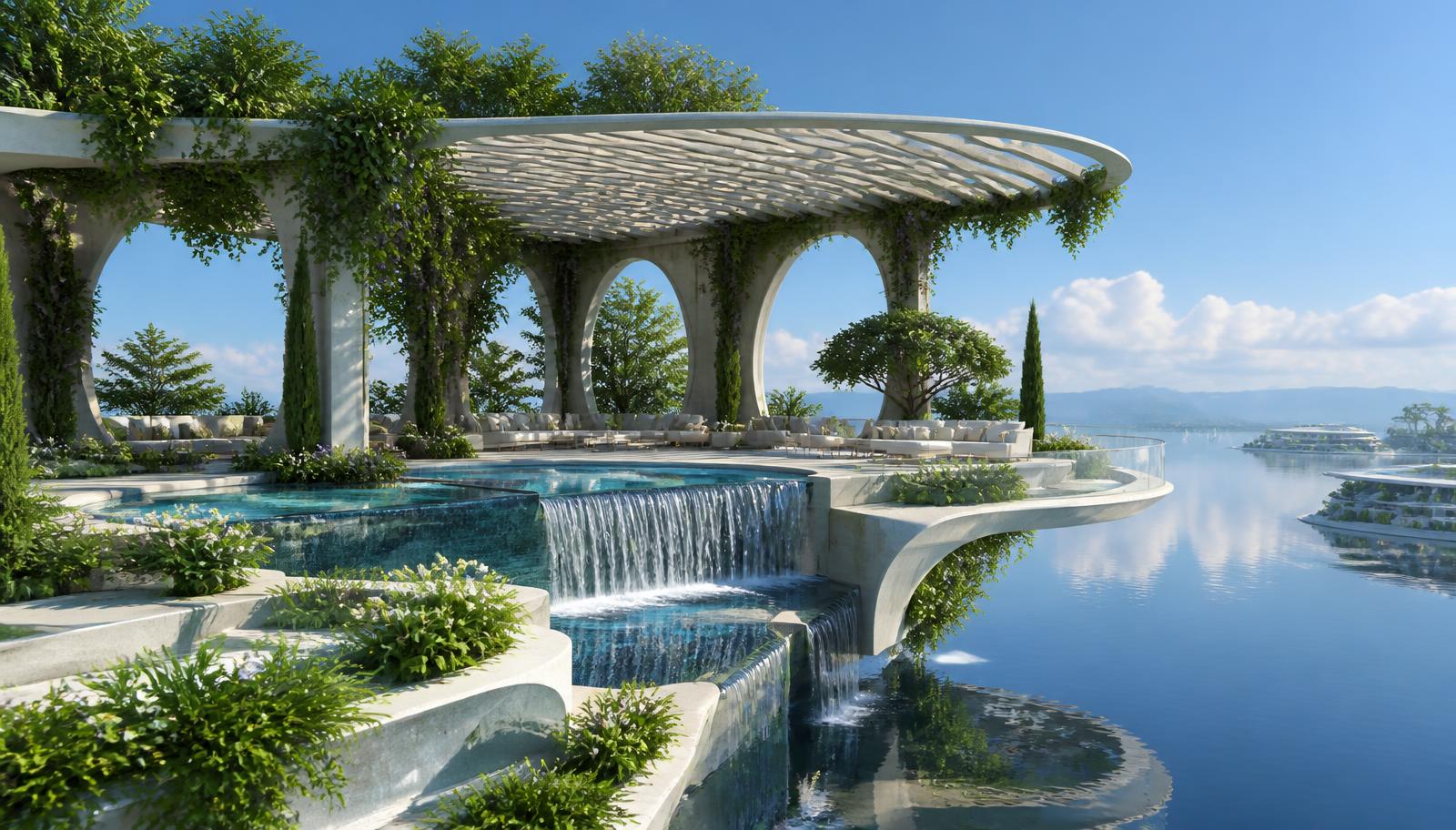
Water-integrated architecture is where garden design becomes sculpture. Terraces cascade, pools spill into pools, and the still water below returns the whole structure as a perfect reflection. Nothing produces a greater sense of arrival for less planting.
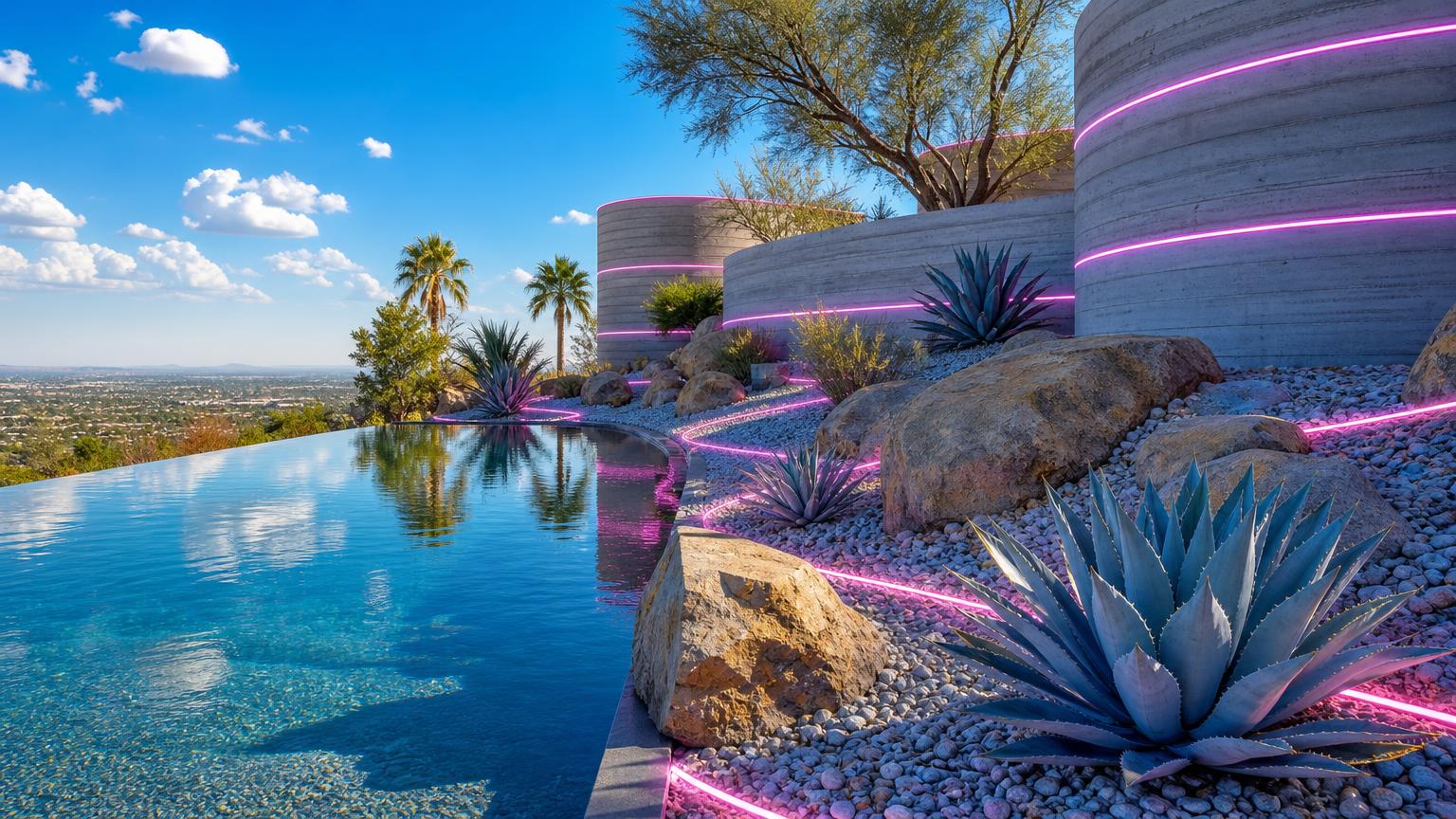
Water-wise, not water-free
Restraint is a future skill, but restraint can still dazzle. Gravel, boulders, sculptural agaves and curved concrete give a garden all the structure it needs on almost no irrigation, while magenta LED strips trace the wall edges so the shadows moving across those surfaces become a performance after sunset.
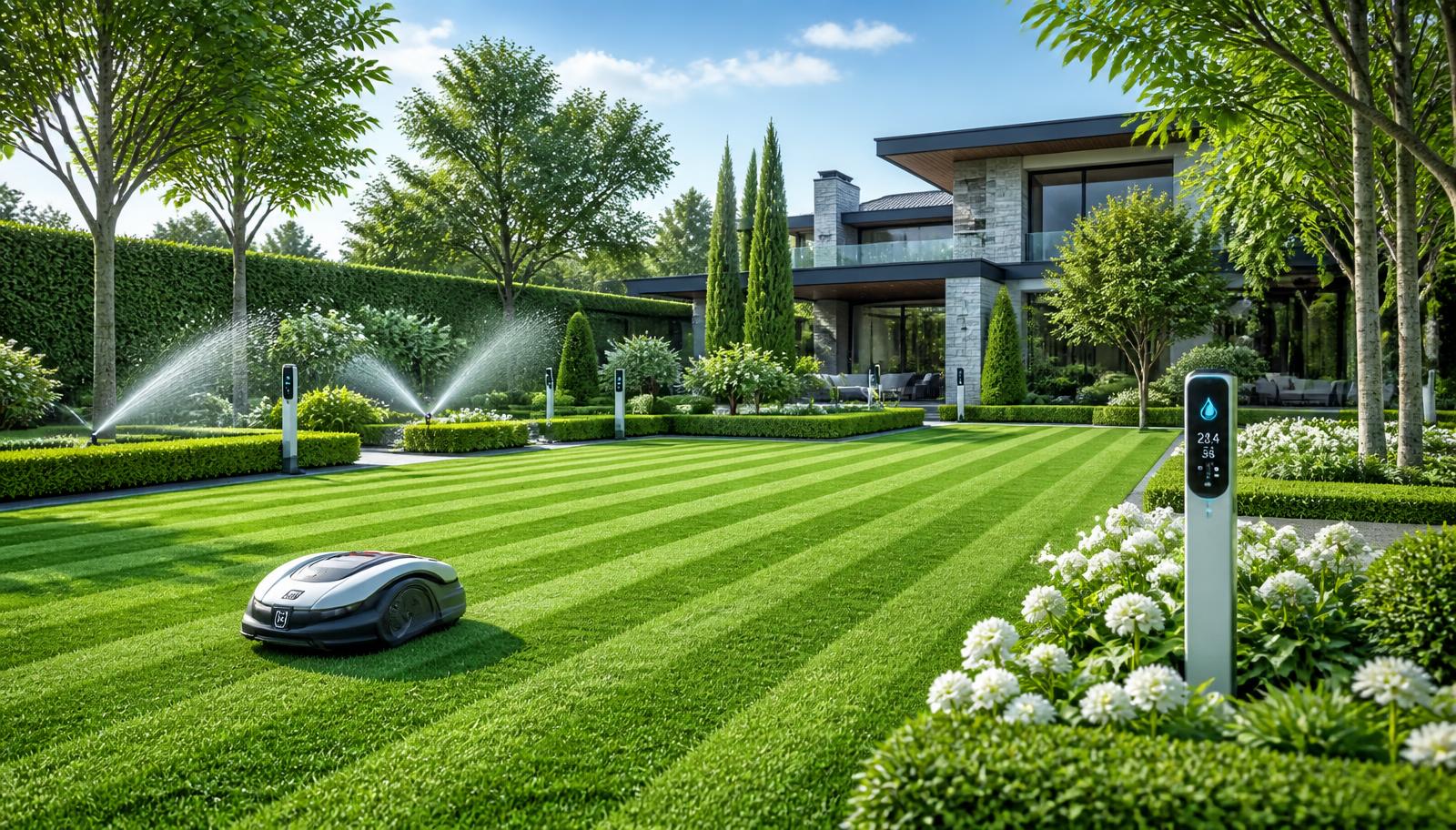
The garden that maintains itself
Robotic mowers, soil moisture sensors and weather-linked irrigation controllers are the least glamorous and most useful part of the future garden. They keep the lawn perfect, cut water use significantly, and remove the weekend chore that makes people give up on planting altogether.
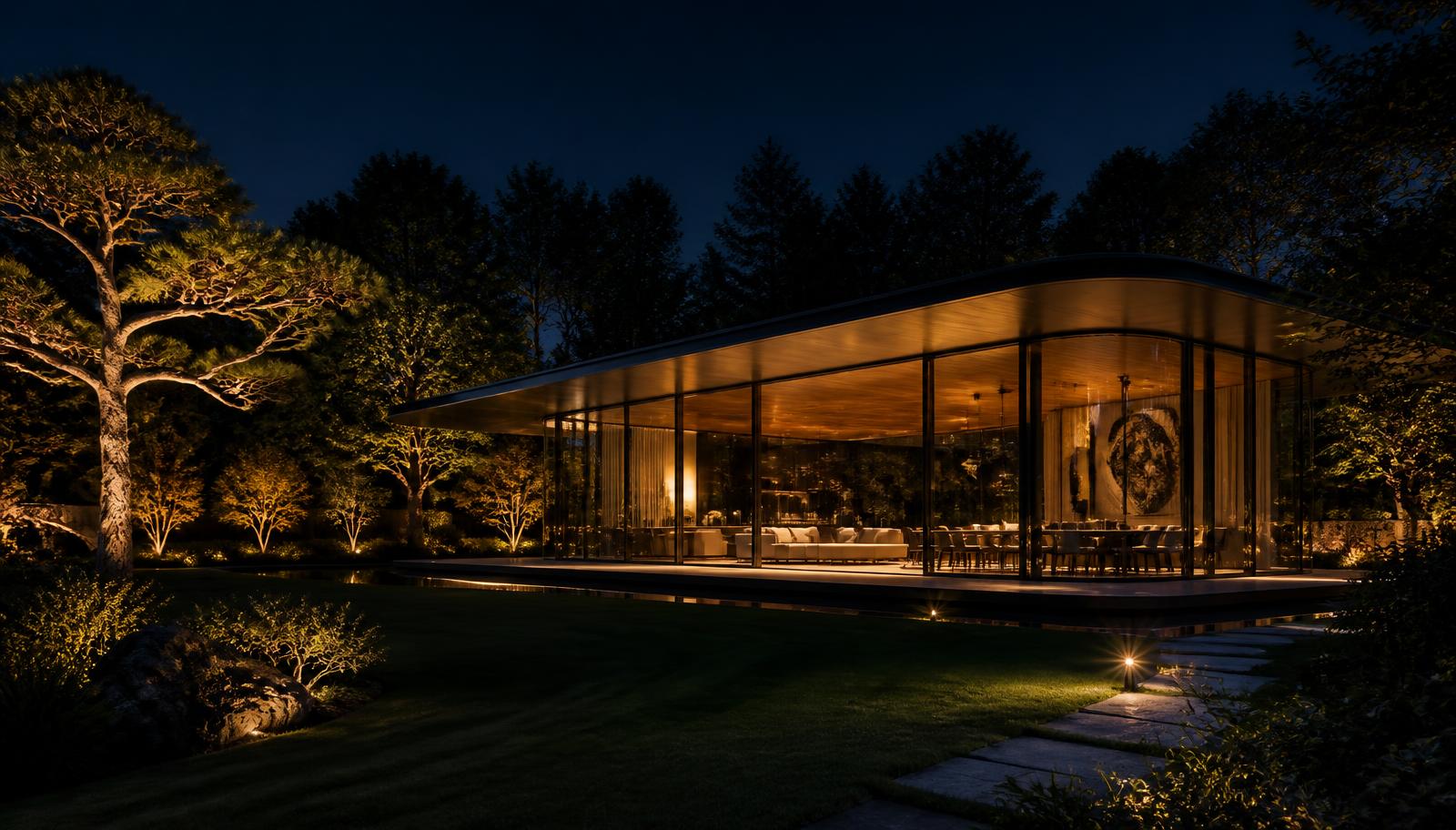
A glass pavilion is the ultimate night-time garden object: the interior light becomes the landscape lighting, the lawn goes black, and a handful of uplit specimen trees define the edges of a garden you can no longer fully see.
Where this is all heading
Future gardens will be climate-responsive, technology-assisted, sculptural and designed for two completely different audiences: the daylight one and the night one. Get the geometry right, plant for your climate rather than your wish list, and spend real money on lighting and water — those are the two things that transform the same garden into a second stage after sunset.